A Break in a Longstanding Mystery about Origin of Complex Life
Breathe easy. It appears our microbial ancestors used oxygen, too.
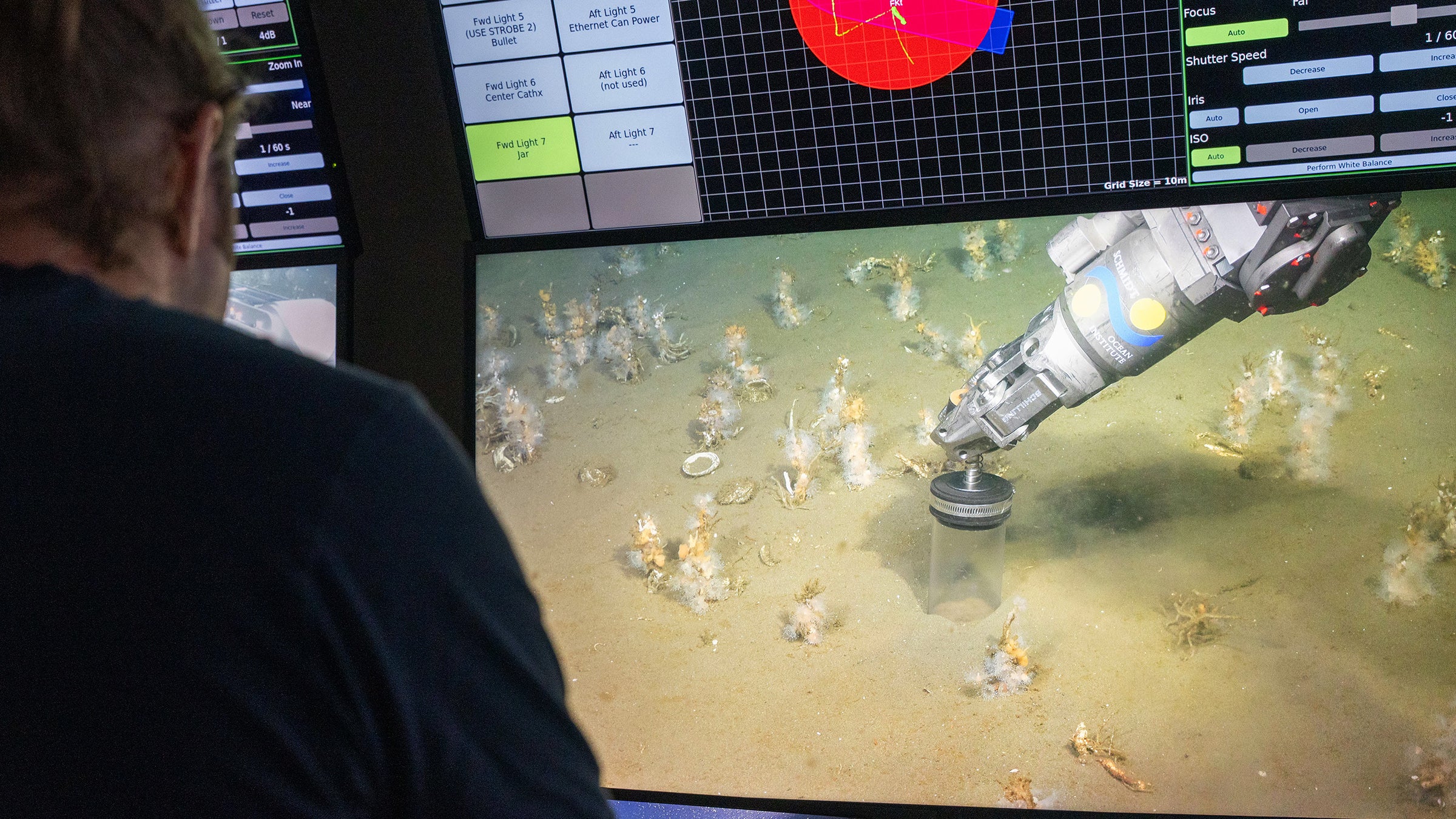
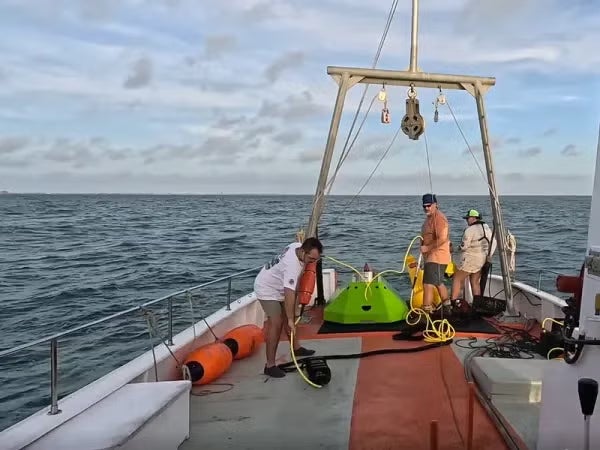
In December 2025, Brett Baker led a research cruise to collect microbial genomes off the coast of Uruguay. In this photo, Tyler Smith pilots a remotely operated vehicle collecting shallow coastal sediments. Credit: Monika Naranjo-Shepard / Schmidt Ocean Institute.
The most widely accepted scientific explanation for the arrival of all complex life on Earth has had an unsolved mystery at its heart. According to the theory, all plants, animals and fungi, known collectively as eukaryotes, are thought to have evolved after two very different types of microbes came together. The problem was in figuring out how the two were in such close proximity in the first place, given that one of the microbes requires oxygen for survival and the other was known to live in spaces without oxygen.
Now scientists from The University of Texas at Austin, publishing in the journal Nature, appear to have solved the mystery. One of our microbial ancestors was part of a group called the Asgard archaea, which today live primarily in the deep sea and other oxygen-free spaces. But according to the new study, some Asgards use, or at least tolerate oxygen. The discovery lends more credence to the idea that complex life evolved as the theory predicted—and apparently in an oxygen-rich environment.
“Most Asgards alive today have been found in environments without oxygen,” explained Brett Baker an associate professor of marine science and integrative biology at UT. “But it turns out that the ones most closely related to eukaryotes live in places with oxygen, such as shallow coastal sediments and floating in the water column, and they have a lot of metabolic pathways that use oxygen. That suggests that our eukaryotic ancestor likely had these processes, too.”
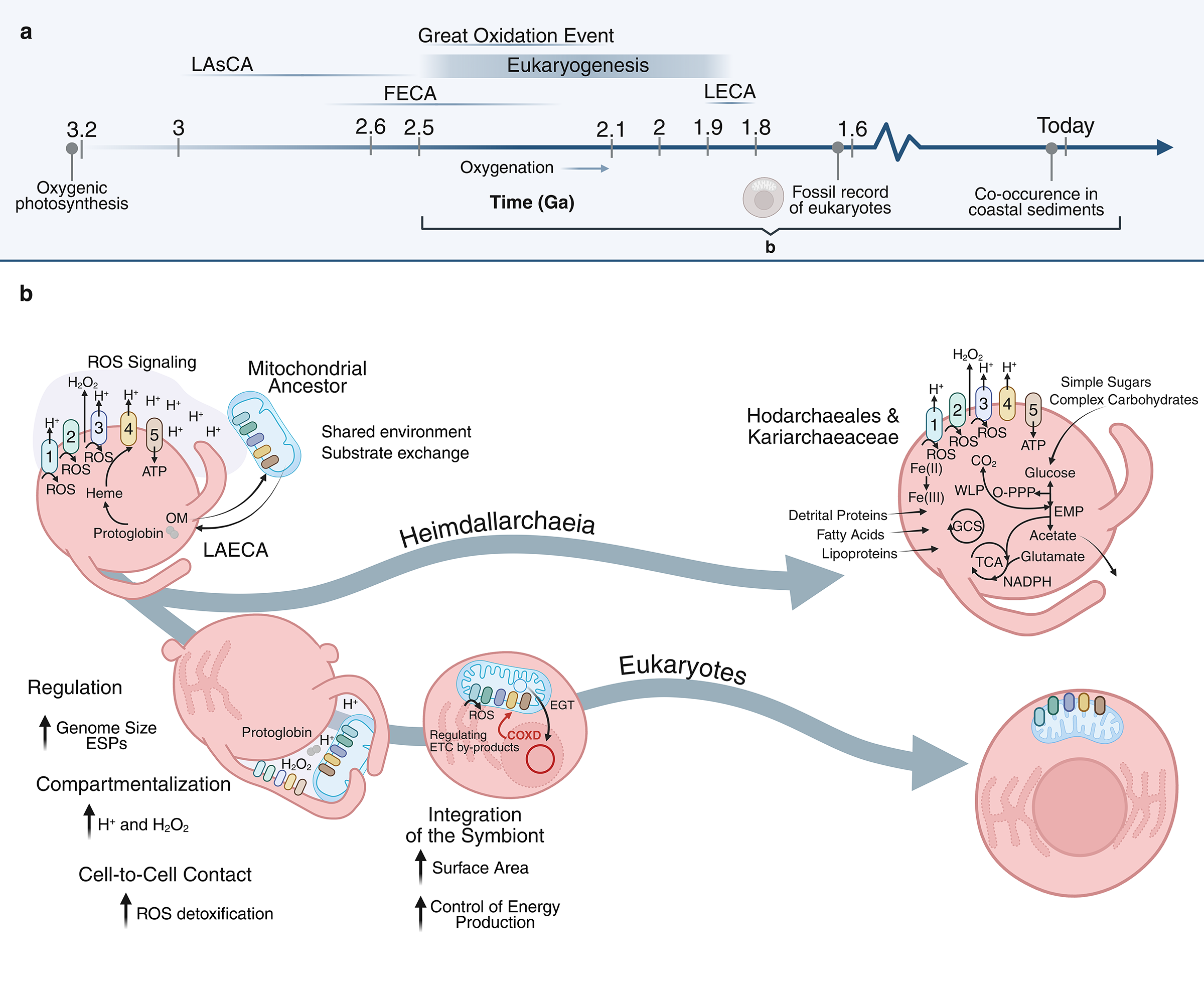
An expanded catalog of Asgard genomes supports a new model of eukaryogenesis, or birth of complex life forms. Credit: University of Texas at Austin.
Baker and his team research Asgard archaea genomes, uncovering new lineages, expanding enzymatic diversity and exploring their metabolic pathways. The team’s latest finding agrees with the picture geologists and paleontologists have reconstructed of Earth’s history. Until about 1.7 billion years ago, Earth’s atmosphere had very little oxygen. Then, oxygen levels spiked dramatically, like levels seen today. Within a few hundred thousand years after this Great Oxidation Event, the first known microfossils of eukaryotes appeared, suggesting that the presence of oxygen might have been important for the origin of complex life.
“The fact that some of the Asgards, which are our ancestors, were able to use oxygen fits in with this very well,” Baker said. “Oxygen appeared in the environment, and Asgards adapted to that. They found an energetic advantage to using oxygen, and then they evolved into eukaryotes.”
Scientists believe eukaryotes arose when an Asgard archaeon developed a symbiotic relationship with an alphaproteobacterium. Eventually, they become one organism with the latter evolving to become an energy-producing organelle within eukaryotes called the mitochondria. In the new paper, the scientists vastly expand the number of Asgard archaea genomes and point to specific types of Asgard archaea, such as Heimdallarchaeia, which are closely related to eukaryotes but less common today.
“These Asgard archaea are often missed by low-coverage sequencing,” said co-author Kathryn Appler, a postdoctoral researcher at the Institut Pasteur in Paris, France. “The massive sequencing effort and layering of sequence and structural methods enabled us to see patterns that were not visible prior to this genomic expansion.”
Funding was provided for this work in part by the Gordon and Betty Moore and Simons Foundations, the National Natural Science Foundation of China and the National Health and Medical Research Council of Australia.
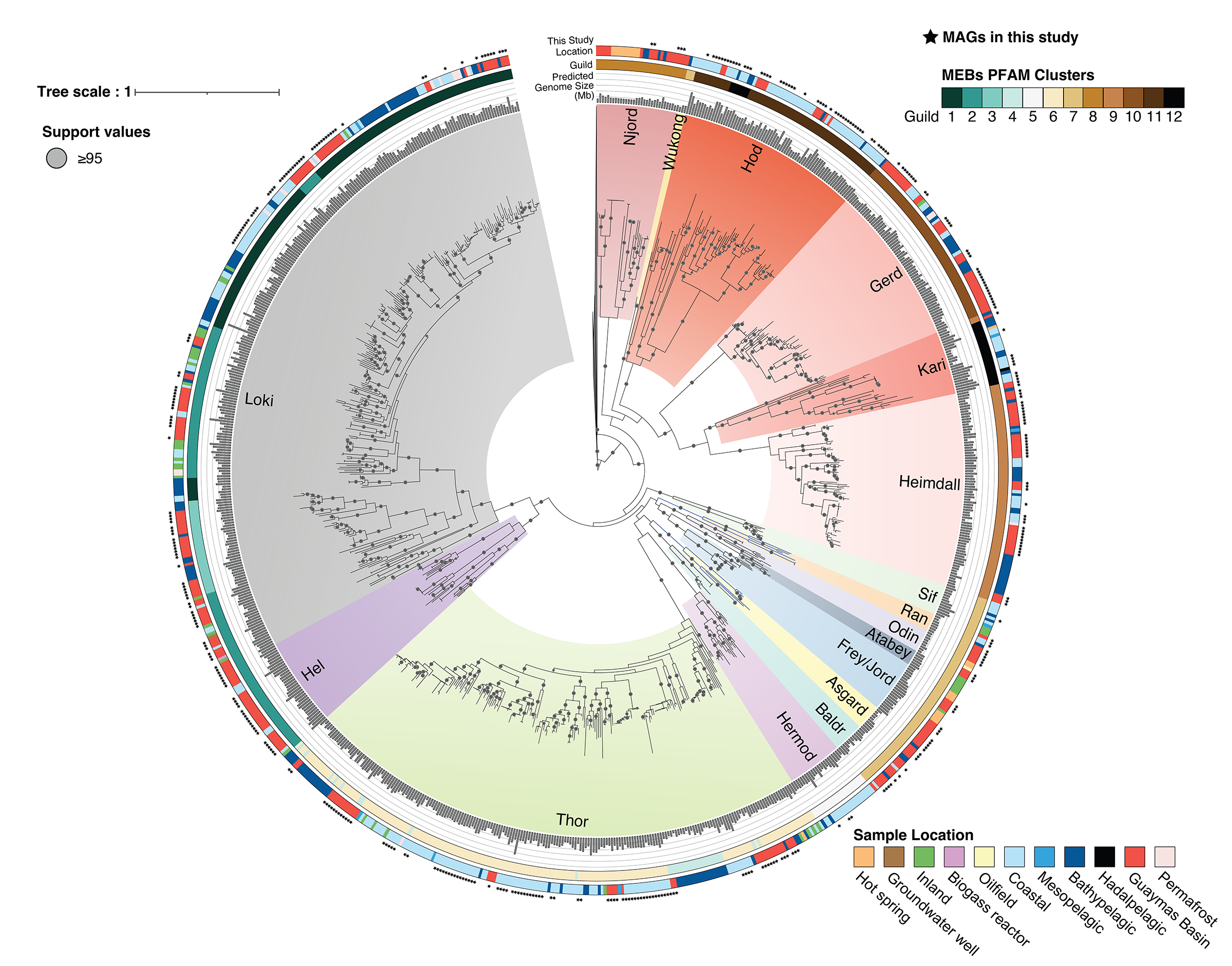
An expanded family tree of Asgard archaea. The concentric rings (in-out) highlight the predicted genome size (Mb), metabolic guilds, sampling locations, and black stars for the genomes added by this study. Credit: University of Texas at Austin.
This research stems from Appler’s Ph.D. work at The University of Texas Marine Science Institute, which started by extracting DNA from marine sediments in 2019. The UT group and its collaborators assembled more than 13,000 new microbial genomes. This massive effort compiled data from several marine expeditions and involved wrangling about 15 terabytes of environmental DNA. From this dataset, they obtained hundreds of new Asgard genomes, nearly doubling the group’s known genomic diversity. Using genetic similarities and differences of these microbes, they constructed a new expanded Asgard archaea tree of life. These new genomes also revealed previously unknown groups of proteins, doubling the number of known enzymatic classes.
Next, they looked at Heimdallarchaeia and compared proteins they produce to eukaryotic proteins involved in energy and oxygen metabolism. Using an artificial intelligence model called AlphaFold2, they predicted how these proteins fold into three-dimensional shapes. The shapes, or structures, of proteins dictate how they function. The results showed that several proteins produced by Heimdallarchaeia closely resemble those used by eukaryotes for oxygen-based, energy-efficient metabolism.
Other authors of the study include previous UT researchers Xianzhe Gong (currently at Shandong University in China), Pedro Leão (now at Radboud University in the Netherlands), Marguerite Langwig (now at the University of Wisconsin-Madison) and Valerie De Anda (currently at the University of Vienna). Additionally, James Lingford and Chris Greening at Monash University in Australia and Kassiani Panagiotou and Thijs Ettema at Wageningen University in the Netherlands participated in the research.