Microplastics in the Sand: Beach Combing Goes High Tech
A UT chemist says it is now time to develop tests for microplastics, similar to tests for other toxic threats.
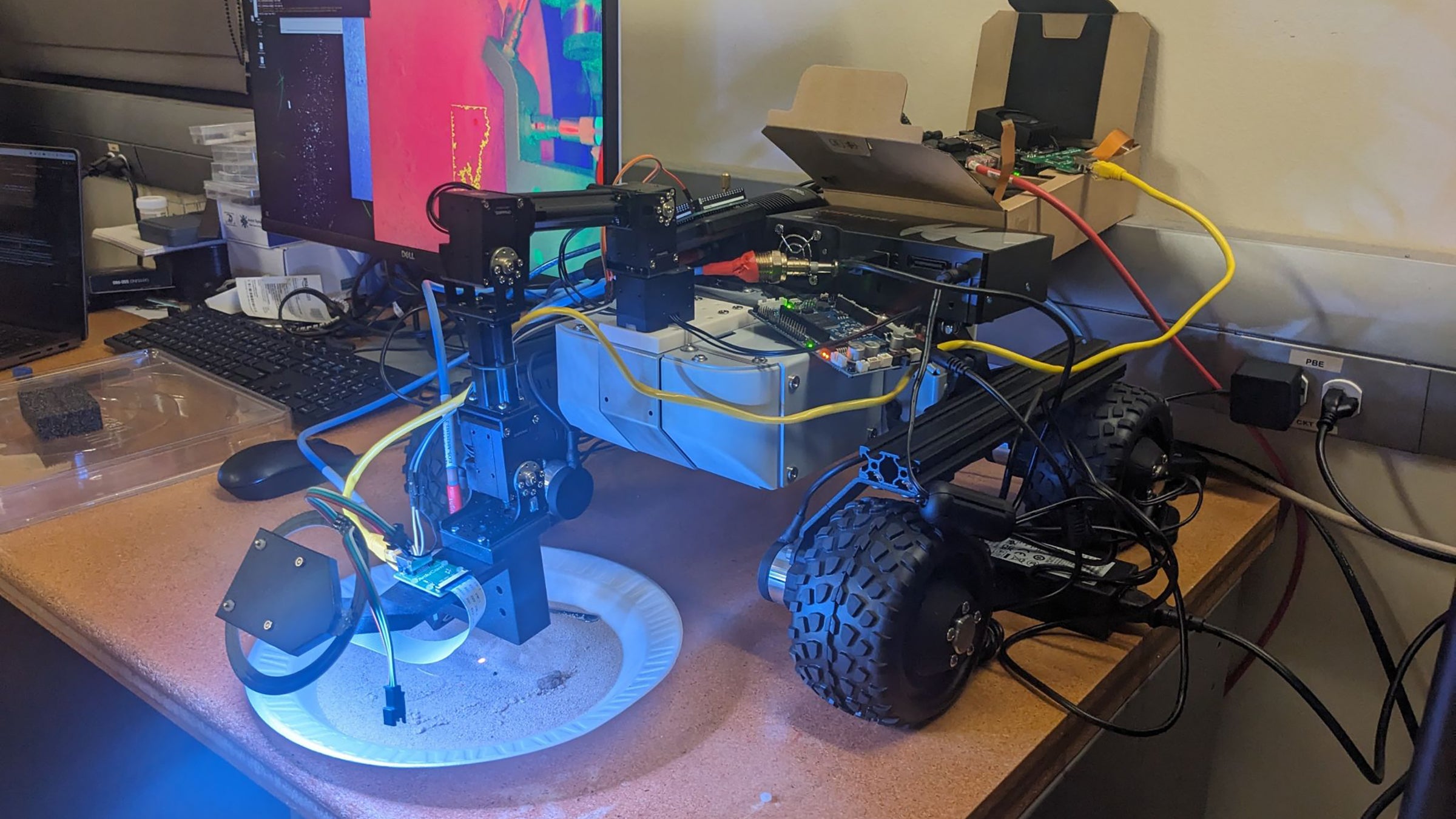
A microplastic-detecting robot developed at The University of Texas at Austin. Photo credit: Christian Claudel.
Bend to pick up a seashell on a Texas beach and if you look carefully, you might notice something surprising in the sand—tiny fibers, flakes and pellets in every possible color. These itty bits of plastic, appropriately called microplastics, pose a danger to both marine organisms and humans because they can release toxic chemicals into the body, penetrate cell membranes and cause proteins to clump together. Endangered animals that populate wetlands and coastal areas, like whooping cranes and sea turtles, risk starvation if they fill up with microplastics that have no nutrients and can’t be digested.
Now an interdisciplinary team of scientists and engineers at UT Austin is developing an autonomous robot that can rove along beaches mapping out where microplastics are and what they’re made of. The goal is to replace some of the time- and labor-intensive work of human monitoring.
Carlos Baiz, a professor of chemistry and co-leader of the project, says there are still many unknowns about what microplastics are doing to us and to other animals and the environment, but it remains difficult to answer these questions without basic monitoring tools. He sees parallels with past public health concerns over exposure to lead from burning leaded gasoline and to asbestos from building materials.
“I think microplastics are our generation’s asbestos or lead,” he said. “We have good tests for lead and asbestos in the environment, but we don’t have good tests for microplastics. So, as chemists, it is on us to develop them.”
Thinking Outside the Box
In the summer of 2021, Baiz was invited to attend a three-day retreat for associate professors from across The University of Texas at Austin to discover ways to collaborate across disciplines using a design thinking approach. There, he met Christian Claudel, an associate professor of engineering who was interested in designing an autonomous submersible robot to identify microplastics in the environment. Baiz liked the idea and suggested ways they could do this with spectroscopy, an approach he had used for many years to study the chemistry of biological molecules.
The pair knew the importance of taking action in their home state. Microplastics are a growing problem across the world’s marine environments and especially troublesome on Texas beaches. The Lone Star state is a major producer and exporter of nurdles—pellets that are later reformed into a host of plastic products like cups and sunglasses and spatulas. The Port of Houston alone accounts for nearly 40 percent of Gulf Coast nurdle exports. Nurdles frequently escape into the environment along the way from the chemical plant to the rail car or container ship. And when they escape near the Texas coast, they’re more likely to stick close to home. A study in 2018 found that, due to unique wind and current patterns, plastic waste of all kinds accumulates at a rate 10 times higher in Texas than in other Gulf states. A more recent study estimated that Corpus Christi Bay alone may contain up to 1 metric ton of polyethelene, just one of many types of microplastic.
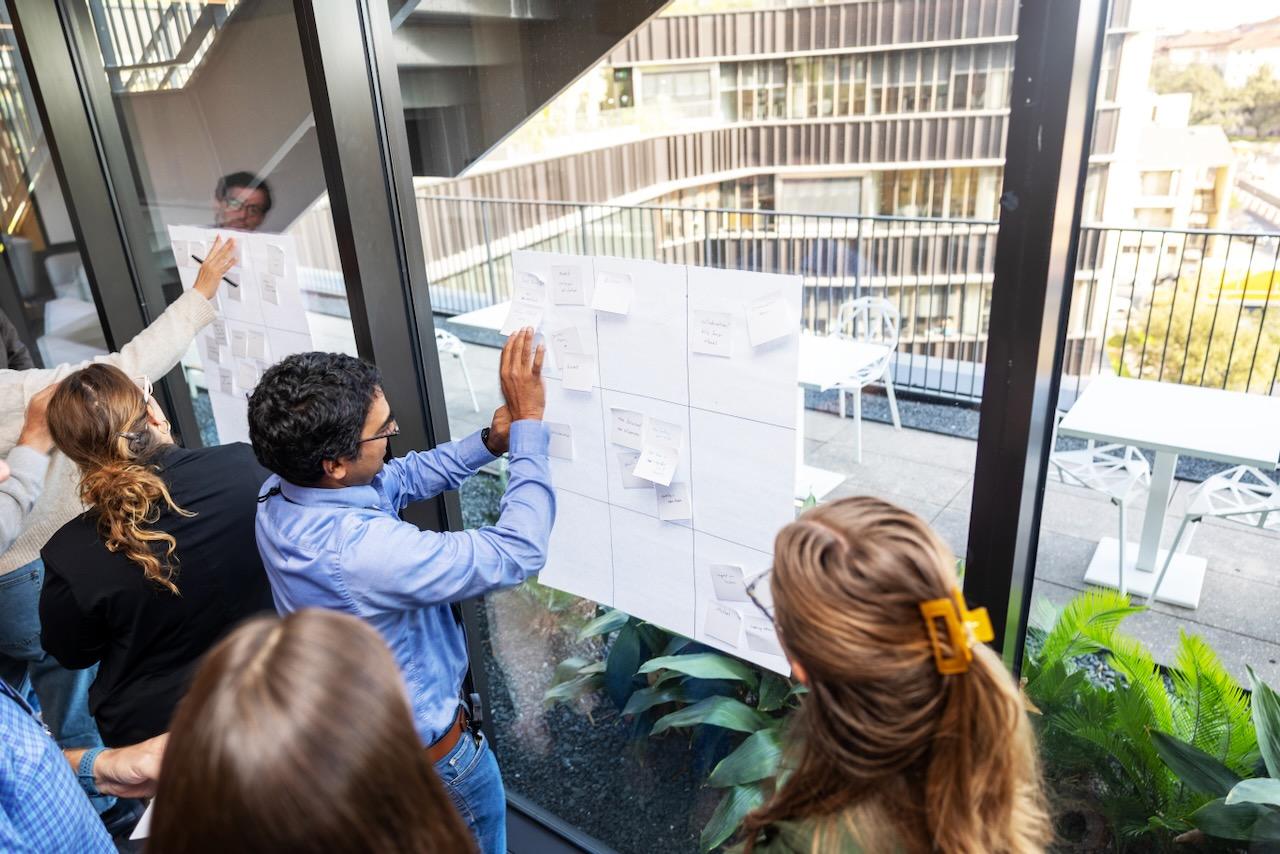
Each fall, newly tenured UT faculty from across campus meet each other for the first time and learn how to design research through a unique retreat. Photo courtesy of UT's Office of the Vice President for Research, Scholarship and Creative Endeavors.
At the end of the Associate Professor Experimental (APX) retreat, the pair wrote a grant proposal to UT’s Office of the Vice President for Research, Scholarship and Creative Endeavors and received initial funding. When their original plan to measure microplastics in the ocean using a robotic submersible and Raman spectroscopy didn’t pan out (Raman spectroscopy is not sensitive enough), they identified a more practical approach, deciding to move the robot to land and switch to near-infrared (NIR) spectroscopy. They built a prototype using mostly off-the-shelf parts modified for this project.
The resulting four-wheeled beach rover is about the size of a toaster. On the beach, it first uses a high-resolution optical camera and an AI model to identify candidate microplastic particles and differentiate them from background materials such as sand, water, leaves and shells. Then it uses a near-infrared spectrometer to record the spectra for each candidate particle. Finally, a machine learning classifier analyzes each spectrum and determines whether it is plastic and if so, what type. The current version of the classifier can distinguish nine common types of plastic including polyethylene terephthalate, polyvinyl chloride and polypropylene.
To train their machine learning classifier, they first created two reference libraries: one of various plastics—including samples of plastic waste from the environment around Austin, including the UT campus, and fresh samples from a commercial supplier—and a second library consisting of non-plastic materials that are commonly in the environment and could potentially interfere with spectral measurements—including water and plant-based materials such as cardboard, paper, wood, bark and dry grass. Then they collected NIR spectra for several examples of each type of item.
If this were only used in a controlled lab setting, that would be enough training data, but the real world is far messier: multiple materials might be mixed together, and other kinds of noise can affect the spectra. So, the researchers created a synthetic dataset that mixed and matched the different spectra from their reference libraries and introduced different levels of noise, yielding tens of thousands of spectra for training.
Based on tests in the lab with samples of known composition, their classifier is already 86% accurate for spectra collected from the nine common plastics it was trained on, and they’re continuing to improve the accuracy.
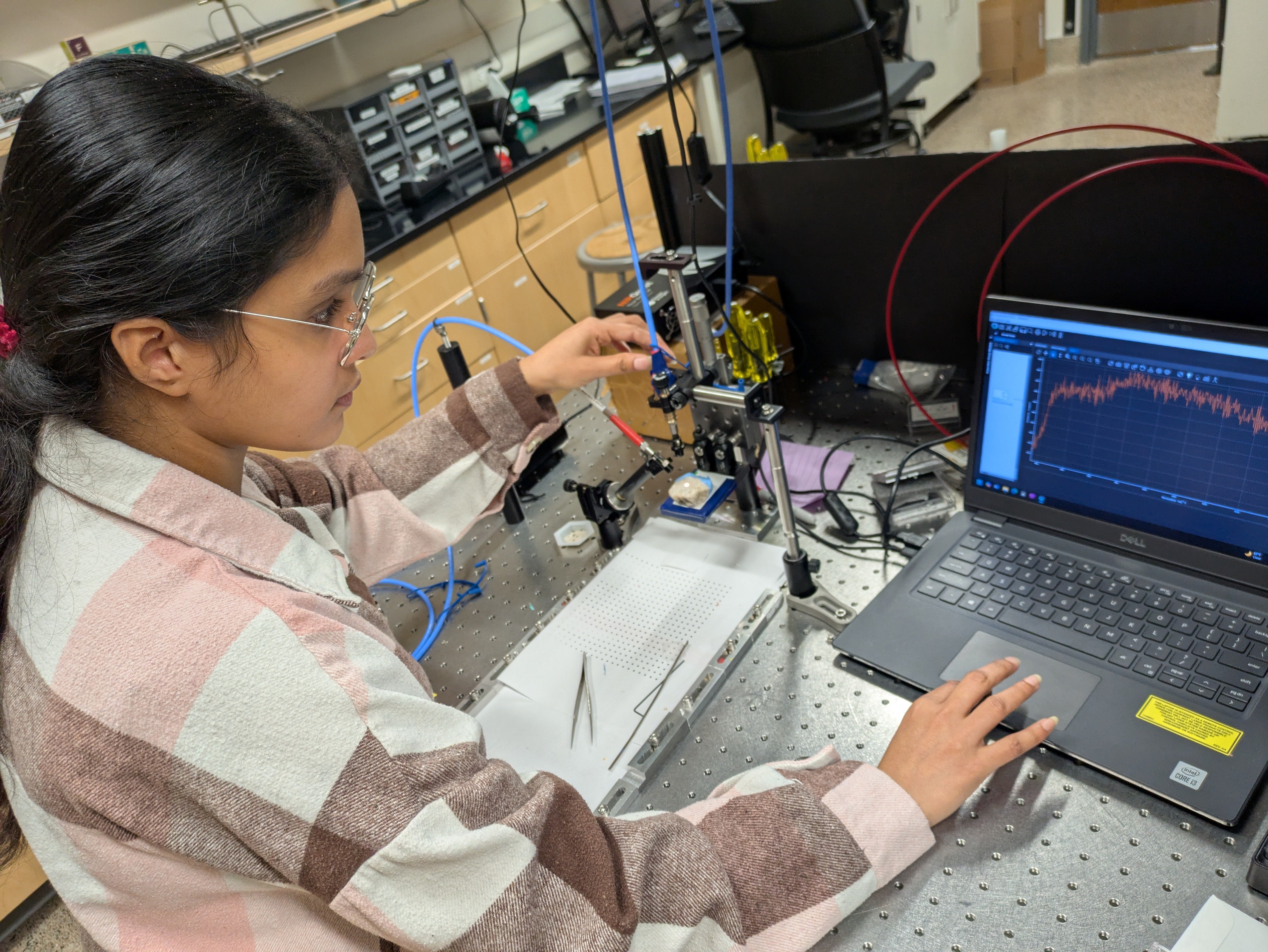
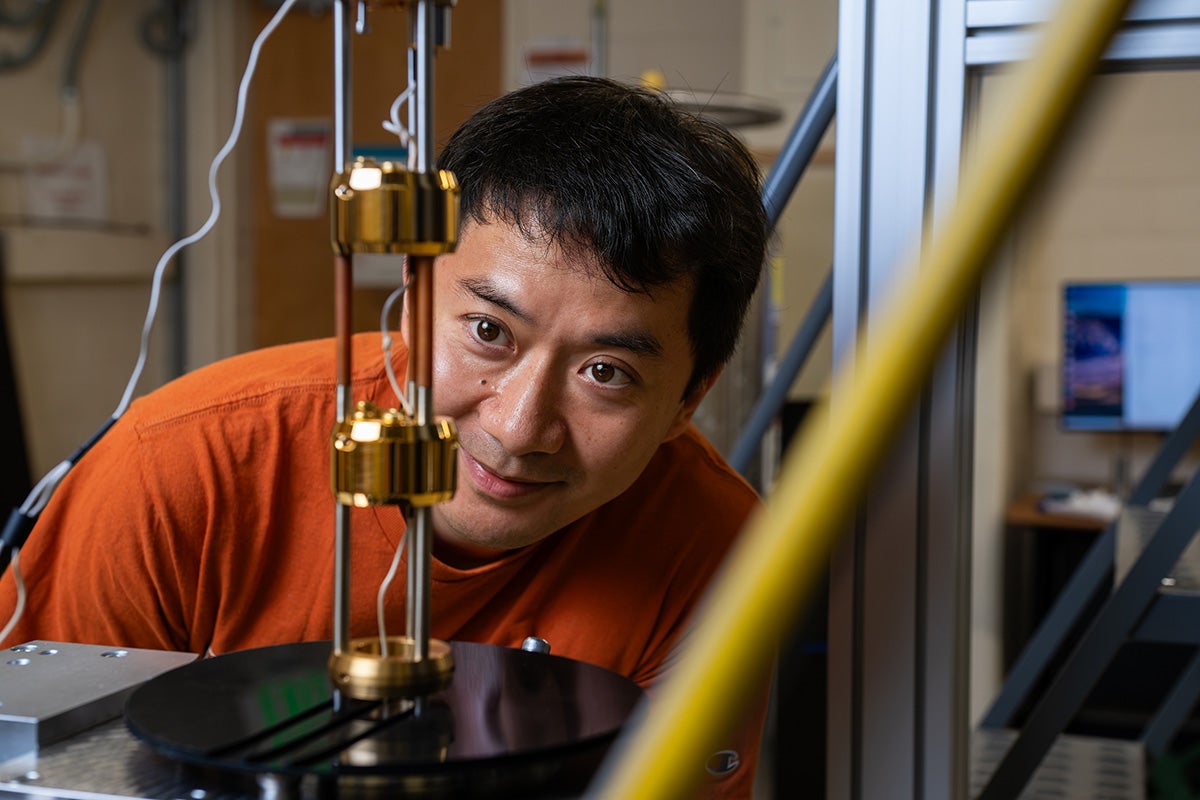
Kobin Antony Rex, a graduate student in chemistry, demonstrates how the robot's near infrared spectrometer collects spectra from microplastic samples that are then used to train a machine learning classifier. Photo credit: Marc Airhart.
Manually sampling microplastics on the beach is very time- and labor-intensive. Scientists typically go out and dig up a few buckets of sand, bring them back to the lab and analyze them. To get a clear picture over a large area while balancing cost and effort, scientists often have to extrapolate between sparse samples. The new rover, although limited to seeing what’s right on the surface, could be a powerful compliment by making it easier to collect continuous data over larger areas.
“When I’m recruiting students, this is the kind of project they’re most interested in,” Baiz said. “Students are always interested in research that has a direct impact.”
Kobin Antony Rex, a graduate student in chemistry, said that’s why she chose to work with Baiz on this project, rather than others.
“I really, really liked this project because plastic pollution is a looming issue, and it’s solving real problems using chemistry,” she said.
Hit the Beach
Baiz, Claudel and Cornel Olariu, a professor in the Department of Earth and Planetary Sciences, currently have a three-year grant from the Matagorda Bay Mitigation Trust to build a working rover and conduct a microplastics survey of the beaches on Matagorda Peninsula. The peninsula is essentially a barrier island situated between Galveston and Port Aransas.
Last year, Olariu conducted a drone survey of Matagorda Bay where he mapped out plastic pollution along the beach to help the team focus on the best places to deploy the rover. By observing which areas are most contaminated with plastics, he was able to identify specific regions of the beach environment where small plastic particles are more concentrated as a result of the tides and wave patterns.
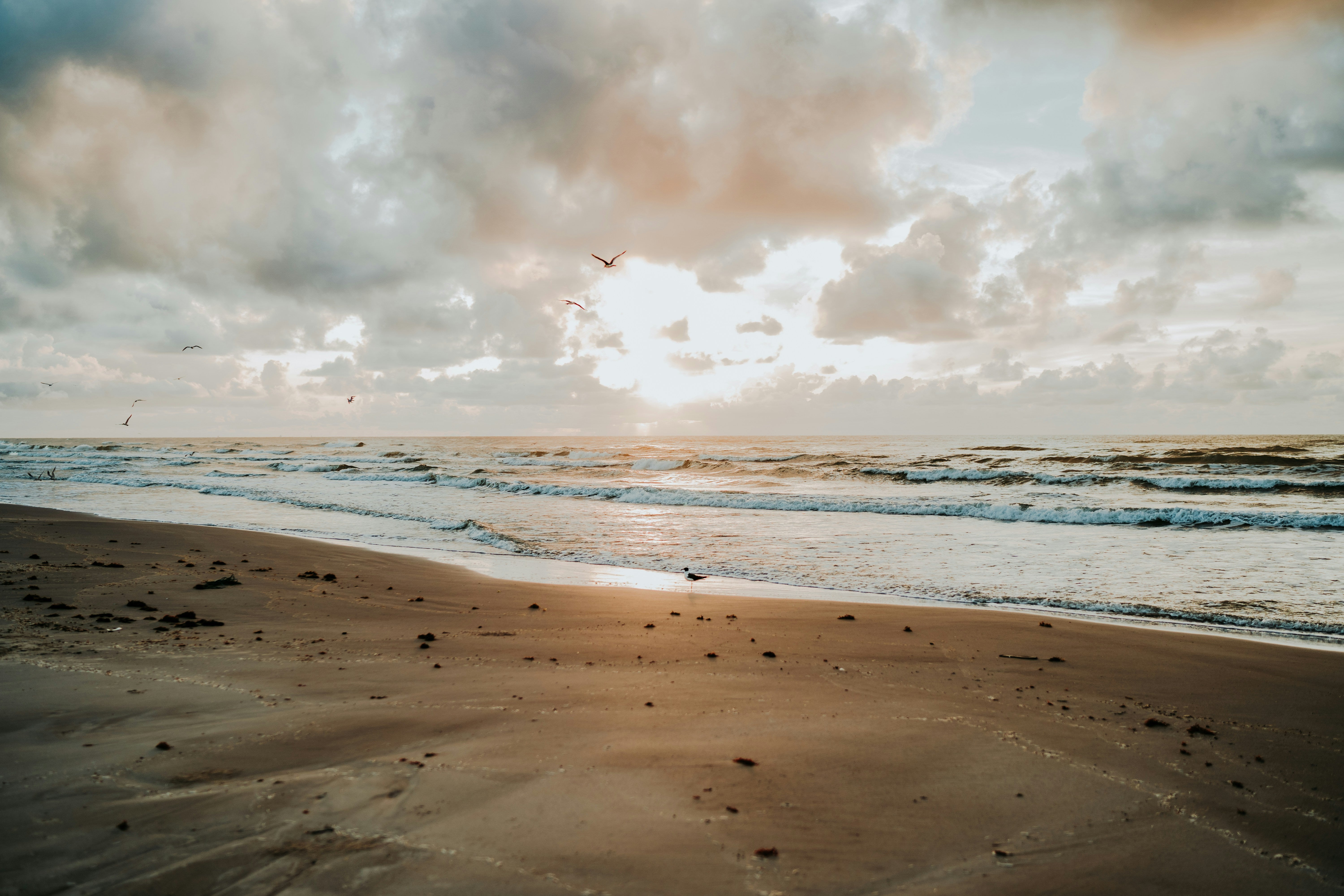
The beach on Padre Island, Texas. Photo credit: Brittani Burns via Unsplash.
Next, the researchers plan to bring the rover to the beaches of Port Aransas near the UT Marine Science Institute for its first practical test. As a part of the University’s Texas Field Station Network, the institute hosts students and scientists from UT Austin and institutions around the world doing a wide range of field research from the area’s beaches to its bays, estuaries and coastal ocean.
Once the technology is proven and the team successfully maps microplastics farther up the coast at Matagorda Peninsula, the researchers have dreams of pushing the technology even farther. Future generations of the rover would ideally be able to detect smaller particles and more types and combinations of plastics, as well as distinguish them from more soil types and environmental substances.
They’re also thinking of applications in other environments, for example, adapting the rover to detect tire rubber from road wear, which is a significant source of pollution affecting fish and other aquatic life in urban environments. Baiz also speculates on developing a version for use indoors.
“What if, before you buy a home, you could have it inspected for microplastics with a robot?” he muses.
Back before he attended the faculty retreat designed to encourage associate professors from different disciplines to collaborate, Baiz’s research was focused on spectroscopy work in the lab, where conditions are neat and orderly and can be precisely modeled. This project has opened him up to working in the wider, messier world.
“The APX retreat gave me the courage to tackle these projects that are very much outside of my area of expertise,” Baiz said. “And since then, we’ve started a lot of new projects that are more outside of what I know best. And I’m really excited to be able to take this research in a new direction.”