Experimental Drug Turns Cancer’s Favorite Fuel—Sugar—Against It
The dual molecule delivers a one-two punch to cancer cells exploiting their hunger for sugar while cutting off their backup fuel supply.
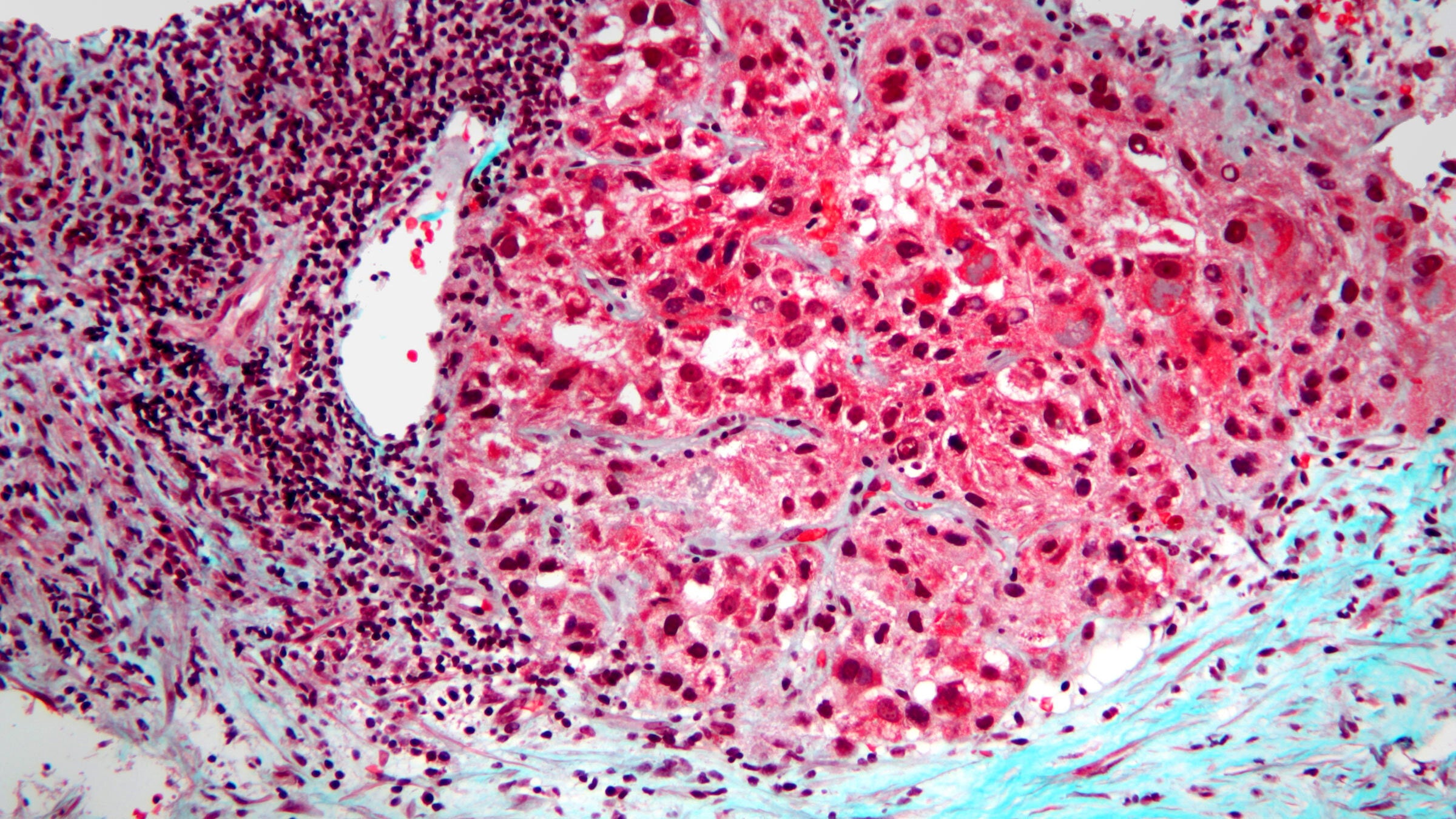
Microscope image of hepatocellular carcinoma, the most common form of cancer to arise in the liver. Photo credit: Wikipedia user Nephron. Licensed under Creative Commons BY-SA 3.0.
Cancer cells have a voracious appetite for sugar—using it to fuel their rapid growth. This is why many scientists have tried to develop drugs that block cancer cells’ metabolism by cutting off their sugar supply.
In a study published in Nature Chemical Biology, a team led by researchers at The University of Texas at Austin demonstrated a fundamentally different approach to targeting cancer metabolism. Instead of starving cancer cells, they trick them into consuming even more sugar than usual. Then, at the same time, the drug blocks their backup fuel source—fat.
By attacking both fuel sources at once, the experimental drug puts cancer cells under so much stress that many of them die. They demonstrated the drug’s effectiveness at treating an aggressive form of melanoma in mice.
“I like to think of this technology like a two-headed dragon,” said Xiaolu (Lulu) Lim Ang Cambronne, an associate professor of molecular biosciences at UT and co-corresponding author. “We are putting one part of the cell into overdrive while simultaneously weakening another part. It appears to be extremely potent.”
In lab experiments, the drug was effective against several types of human cancer cells, including melanoma, leukemia, breast cancer, lung cancer, liver cancer and neuroblastoma. In the mice with melanoma, most cancer cells died, while non-cancerous cells were much less affected.
Drugs that attack cancer with this kind of molecular specificity are not totally new. A growing class of compounds called antibody-drug conjugates (ADCs) use an antibody to target cancer cells, then deliver a payload of chemotherapy right to the tumor. But ADCs have many limitations.
“Antibodies are difficult to make, and because they’re so large they’re only able to target proteins in the surface of cancer cells,” said Ken Hsu, an associate professor of chemistry at UT and co-corresponding author. “We think of this new compound as a fully chemical counterpart to ADCs. They are much easier to manufacture. And because they are smaller, they are able to target even proteins that are inside cells.”
This work was supported by the National Institutes of Health, the National Institute of General Medical Sciences, the Cancer Prevention and Research Institute of Texas (CPRIT), the University of Washington Beckman Cryo-EM Center, West Virginia University’s Visual Sciences CoBRE program, the Melanoma Research Alliance, the Mark Foundation for Cancer Research, The Welch Foundation and Tito’s Handmade Vodka.
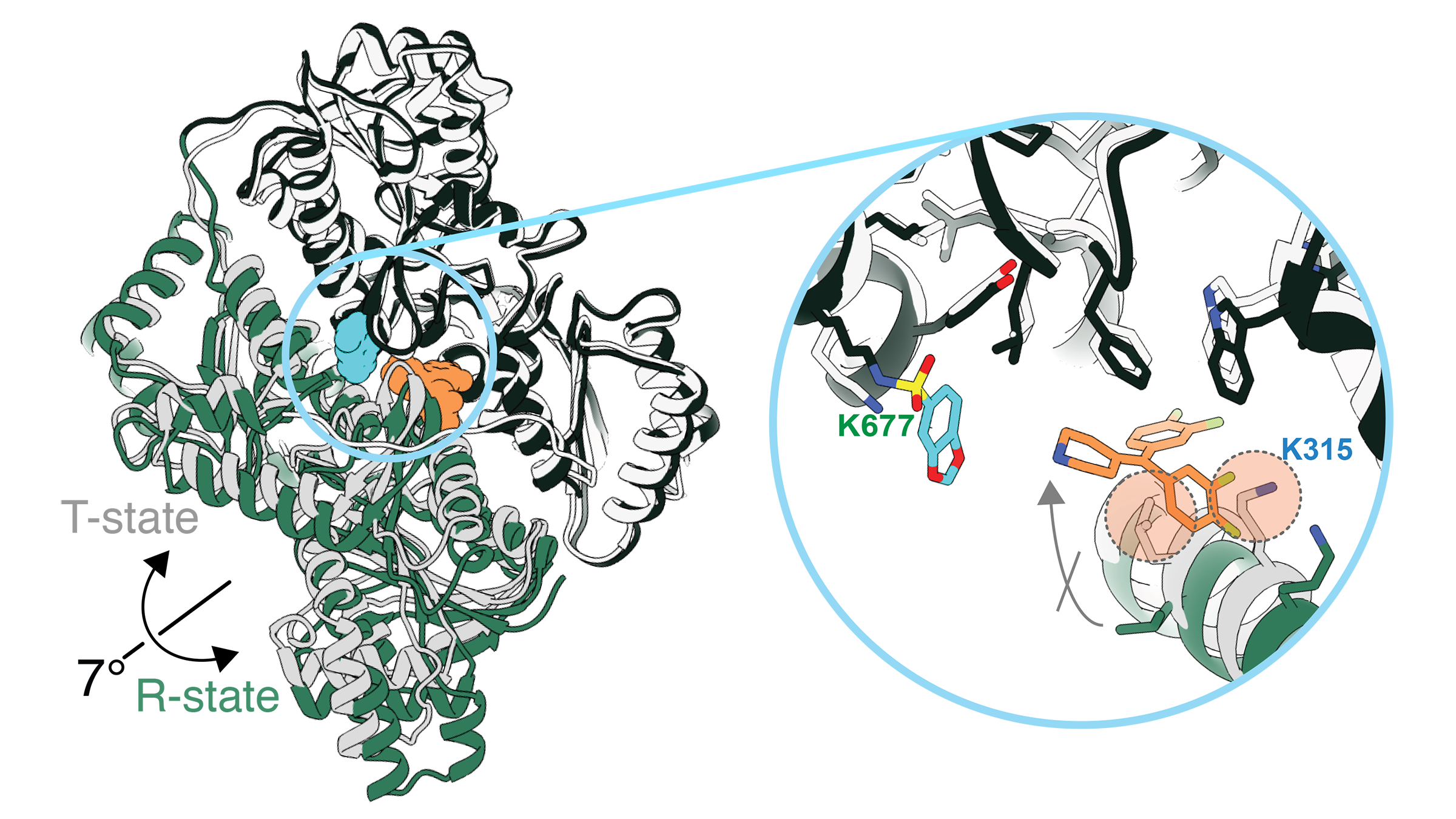
PFKL is an enzyme in cancer cells that metabolizes sugar. This image shows the protein structure of PFKL bound to two parts of the experimental cancer drug XJ-4-85 (blue and orange). When XJ-4-85 binds the sites K677 and K315 on PFKL (inset), it boosts sugar metabolism and releases a payload (not shown) that shuts down fatty acid metabolism. Credit: Eric Lynch (University of Washington) and Xiaoding Jiang (University of Texas at Austin).
The drug has two parts. The targeting agent, a molecule called XJ-4-85, acts on an enzyme called PFKL, speeding up the breakdown of sugar inside cancer cells. After the molecule binds, it releases its payload, a compound that acts on another enzyme called CPT2. CPT2 normally helps cells break down fatty acids for energy. By disrupting both of the cells’ major energy sources at the same time, it shuts down cancer growth.
“The way this drug works was totally unexpected,” said Xiaoding Jiang, a postdoctoral fellow in the Hsu Lab, who designed the molecule. “A lot of research was required to figure out what it was doing on the molecular level. We were also surprised to see how selectively it binds to cancer cells.”
The research is still in its early stages. Although the results are promising, much more laboratory testing is needed before the drug can be studied in people.
Beyond this particular drug, the researchers say this research also illustrates a new broader approach for designing these two-part medicines, which they call “electrophile-drug conjugates” or EDCs. “They have the potential to be useful beyond cancer, for other kinds of diseases as well,” Cambronne said.
The team members emphasize the importance of collaboration in making this discovery possible, bringing together experts from across UT—and beyond. “This project took a village,” said Hsu, a CPRIT Scholar.
The study’s other UT authors are Congcong Lyu, Crystal Wilson, Scott Lyons, Mu-Jie Lu, Shuangyu Luo, Gibae Kim, Hsin-Ru Chan, Wesley Wolfe and Yi-Chih Lin. Authors also include Eric Lynch, Lauren Salay and Justin M. Kollman from the University of Washington in Seattle; Hayden Hess and Bradley Webb from West Virginia University; and Lauren Zacharias and Thomas Mathews from Children’s Medical Center Research Institute at The University of Texas Southwestern Medical Center.