Six Lessons from a Legendary UT Science Teacher
On moving day, a veteran scientist and teacher looks back on lessons learned in the college.
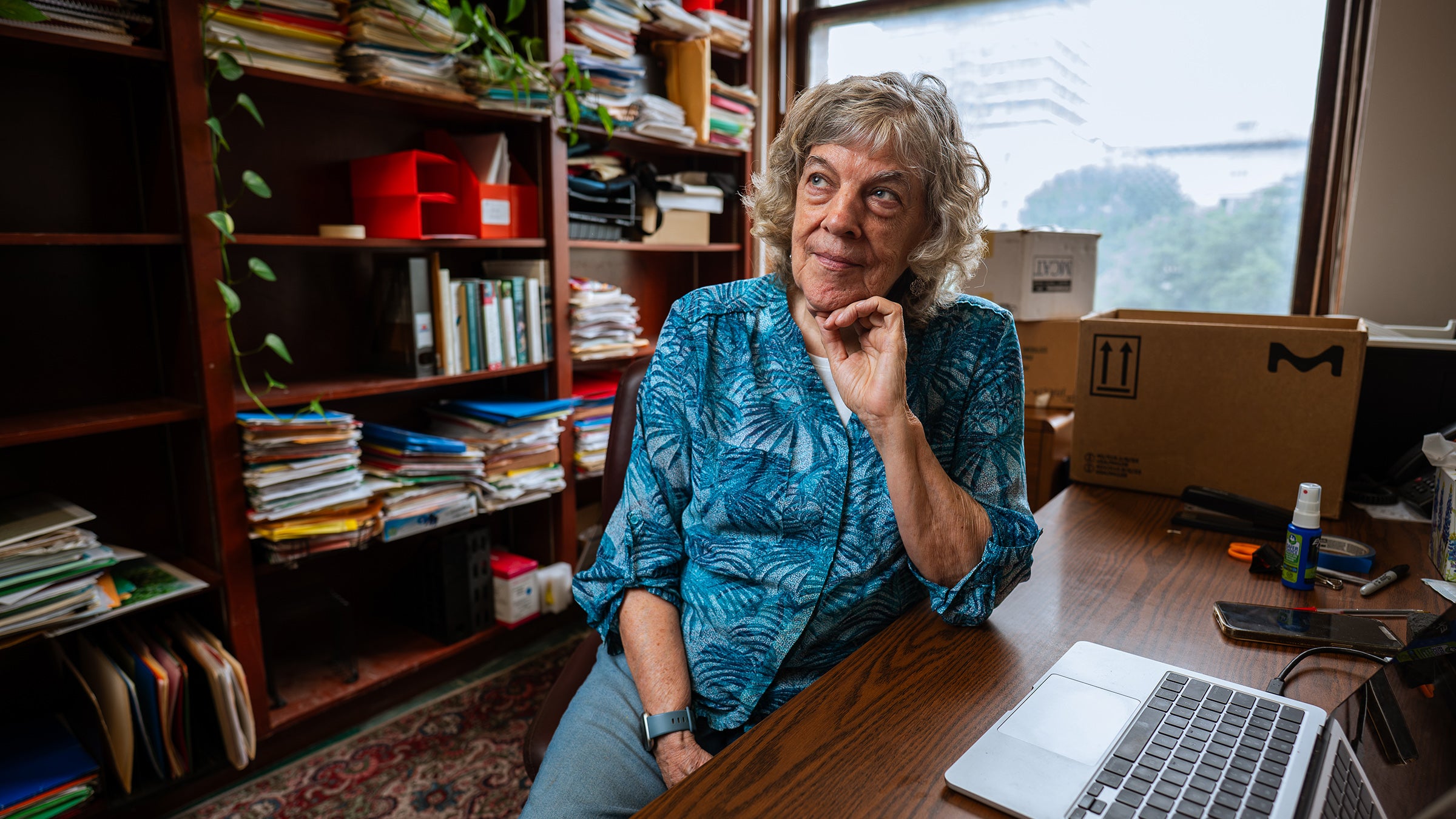
Ruth Buskirk. Photo credit: Eileen Chong.
The door of Ruth Buskirk’s office is covered with nature photos—an owl, a sea turtle, a baby penguin, fall leaves—and with stickers, sporting everything from self-care tips to affirmations.
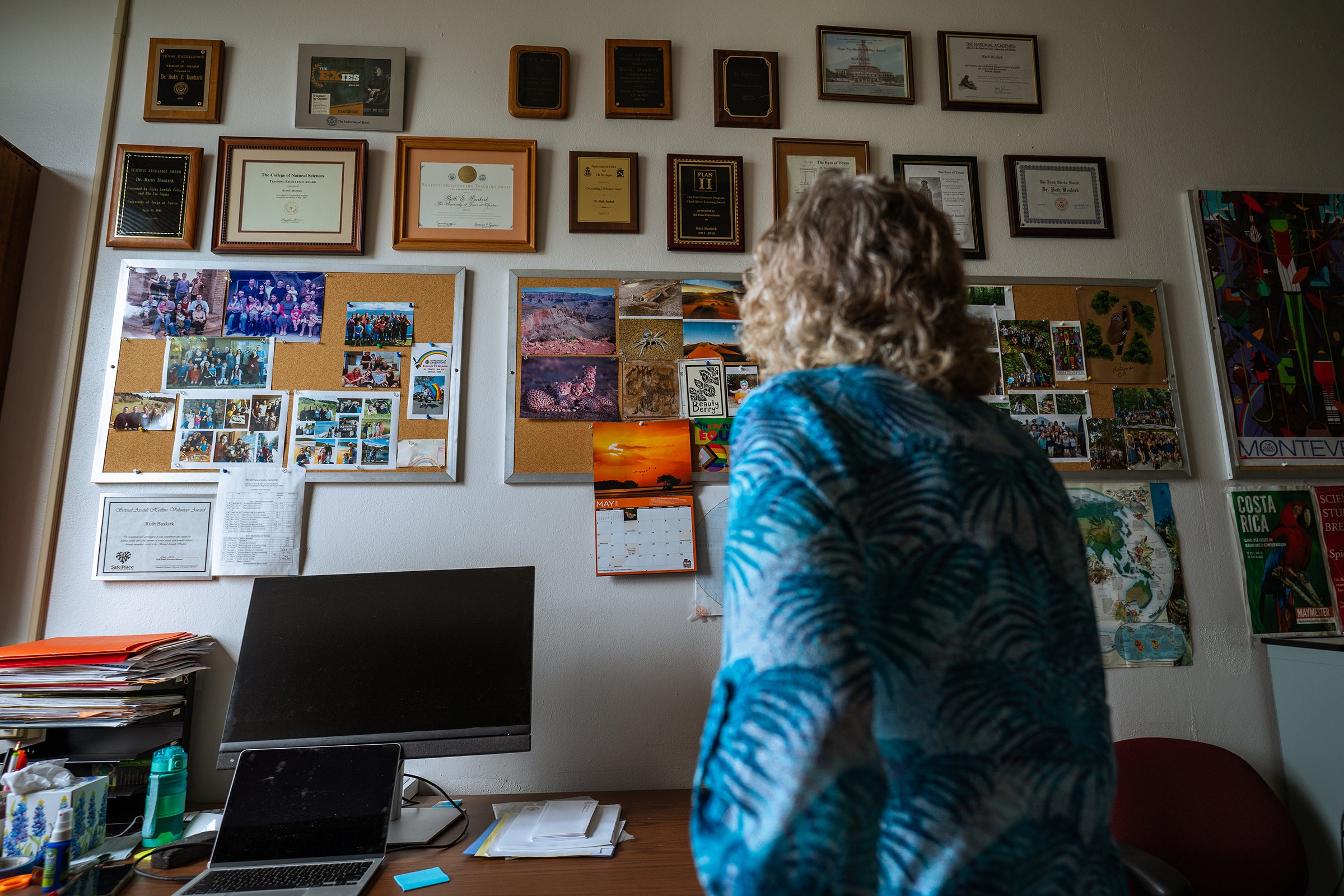
Inside the long, narrow office a window looks out over the turtle pond to the iconic UT Tower on a quiet day on campus. One wall is covered floor to ceiling by dark wooden shelves overflowing with textbooks, notebooks, student files, and notes from Buskirk’s own time as a graduate student. The other wall is a gallery of photos, maps, posters and certificates.
The distinguished senior lecturer and newly minted retiree stands in the middle of what amounts to an archive of five decades of biology research and teaching. She’s clearing out her office, trying to decide what to keep and what to let go of—and sharing insights from her time in the College of Natural Sciences that new generations can benefit from.
“It’s been kind of like ‘This is Your Life’ as I go through,” she says.
Lesson #1: When Students Know They Belong, They Thrive.
Buskirk shows me a stack of “get to know you” index cards that students filled out for years on the first day to introduce themselves. They smile at us from little glued-on headshots. They say things like: “Nothing makes me more alive than discussing topics I’m passionate about. Also, I have two tortoises that I love very much,” or “I biked from Houston to Anchorage this past summer,” or “I learn and perform Indian classical dance called Bharatanatyam.”
“They’re fascinating,” she says. “That’s why I could not throw them away.”
It’s a reminder of one of the many ways she connects with students. On the shelf, a box that reads “Snacks for Stress Reduction” awaits hungry students dropping in for her generous office hours.
Over the years, Buskirk learned that for students to reach their full potential, they have to feel a sense of connection and belonging. She often tells her students how, when she left the Midwest and went to Harvard for graduate school, she felt like an outsider. The other students seemed so much more sophisticated in how they talked and dressed.
“It was awful at the beginning,” she recalls.
But then after a semester of taking challenging courses, she realized she was actually a quick learner, which built her confidence. And she started to make friends.
“I tell that story to my students, and like a year later, somebody will come, and they’ll say, you told me that story about Harvard, and it really hit me, I feel the same way,” she says.
Her own research on teaching affirmed that when an instructor shares how they found a sense of belonging, the students identify with it and they become more effective learners.
Ruth Buskirk. Photo credit: Eileen Chong.
Lesson #2: Remarkable Students Can Make Teaching the Best Work.
On the wall hang countless framed certificates, attesting that Buskirk has received pretty much every teaching award or honor a faculty member can get at the University, including the UT Regents Outstanding Teaching Award and the President’s Associates Teaching Excellence Award. She was also named a Provost’s Teaching Fellow, a Dads’ Association Centennial Teaching Fellow, a member of the University’s Academy of Distinguished Teachers and one of the Texas Exes’ Texas 10.
Originally, conducting scientific research, not teaching, was her plan. After receiving her Ph.D. in biology, she came to UT to make new discoveries. And she did: A kind of Costa Rican spider unexpectedly lives together in groups, enabling them to catch more prey than solitary spiders. And some animals that have been known to behave oddly before earthquakes, such as catfish and snakes, have the sensory capacity to detect subtle cues beyond human sensory range that may presage an impending quake. These types of explorations were her focus, until one day in the early 80s.
“I remember the chair of the zoology department called me and said, we have an opening in a month, can you please teach this course for us? And I said, ‘What?’” (As she says this, her face says: You must be joking.) “And he said, I know you can do it.”
She found teaching extremely challenging at first, but research grants were getting harder to come by. She found she actually relished the challenge of growing as a teacher, so she pressed on. Eventually, she was offered a full-time teaching appointment.
Over the years, she taught more than 20,000 students, some of whom went on to become scientists, physicians, business leaders, lawyers and even a gold medal Olympian. Several current faculty members at the University learned from Buskirk, including two currently in Natural Sciences, Steven Vokes and Edward Marcotte. Both were part of a summer undergraduate research experience that she organized for many years.
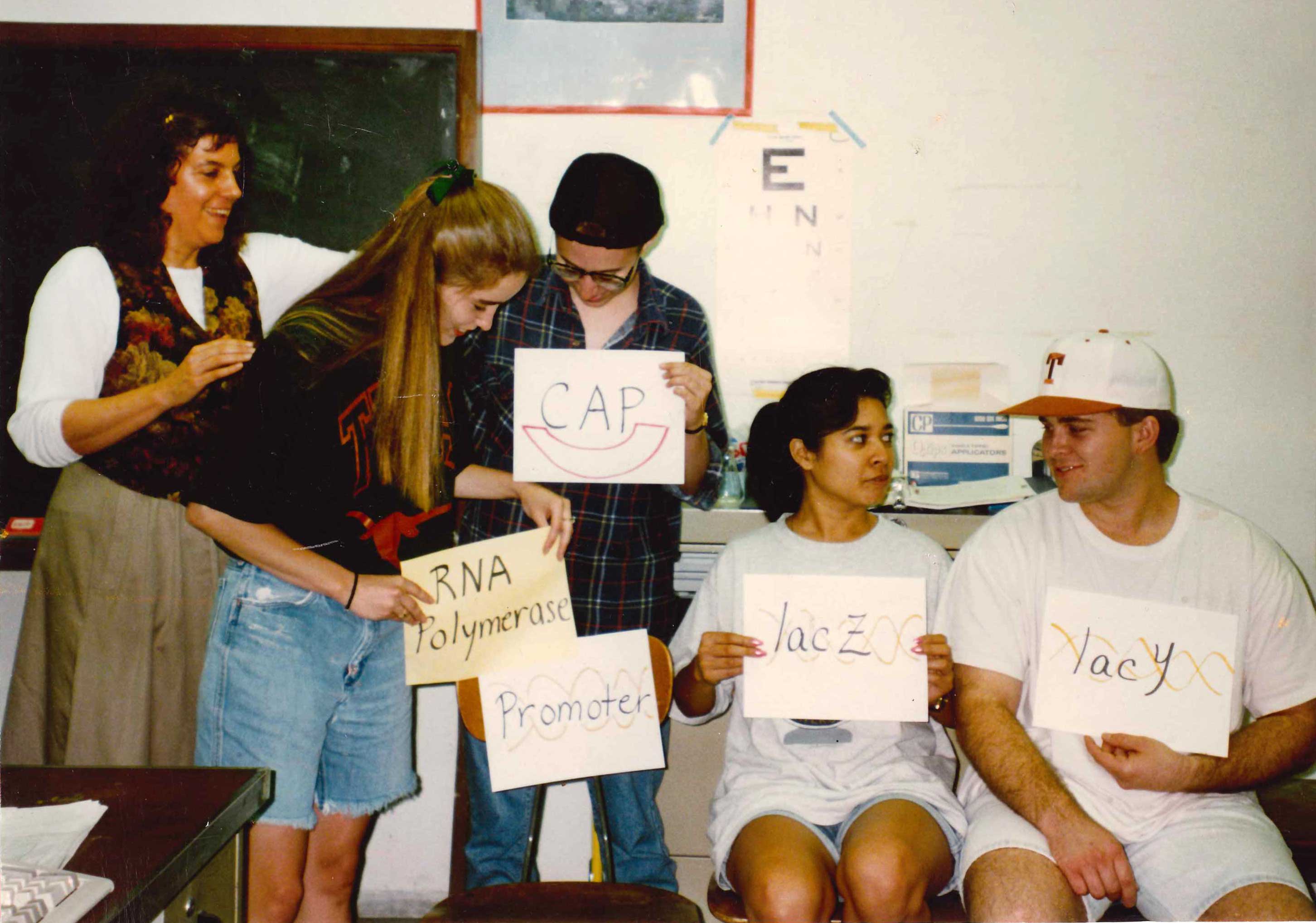
Ruth Buskirk, left, demonstrates a simple way to explain the not-so-simple process of transcription of bacterial genes (1995). Credit: Dee Silverthorn.
Lesson #3: When Learning is Hands-on, It Sticks.
Buskirk points to a pile of pipe cleaners on the shelf that she uses to teach students about chromosomes and genes and about the processes of cell division. The technical term is “manipulatives.” Held in a hand, they can make abstract concepts seem more concrete and relatable. She says the biggest change she’s made in 42 years of teaching has been shifting to active learning. And she wasn’t alone. It’s part of a bigger trend in recent years across the college and the University.
“At the time, I thought the perfect class was a perfect lecture, where you stand up there and talk all the time,” she says. “Their brains are empty—open head and pour in. But I have totally changed my model. You’ve got to get the students involved.”
She started having students act out processes that are happening at the molecular and cellular level, for example, different kinds of metabolism.
She also started inviting students in her Intro Biology II courses to go on optional mini-field trips. Participants would meet up for 15 minutes at some spot on campus—like the turtle pond or the Architecture courtyard with a budding magnolia tree—and talk about what they observe and ask questions.
“The first thing is it gets them to notice what’s around them,” she says. “And then it gets them to ask questions. It gets them to think like a scientist. And they really love it. I’ll run into former students years later and they ask if I still do the mini-field trips. I’m even writing up a paper on it.”
Ruth Buskirk. Photo credit: Eileen Chong.
Lesson #4: Begin with the End in Mind.
Another big change, that engaged students more fully in the learning process, was to incorporate “learning outcomes” into her classes. These are not just pieces of content students should know, but also actions they should be able to do with that content.
For example, she might start a lecture by saying one of the learning outcomes is to understand how mitochondria work. Then at the end of the class, she might ask them to reflect on what they learned and whether or not they could remember and apply it later. For example, could they draw a picture of a mitochondria and tell how the structure is related to function? This causes the students to think about their own learning, which helps them see where there are gaps they need to work on. The fancy term for this now-fashionable educational strategy is metacognition.
Buskirk and other Introductory Biology instructors were invited by the provost’s office in the early 2000s to help transform the way that introductory biology was taught at the University. One of the key changes they implemented was to use student learning outcomes. This was also part of a general pedagogical trend at universities.
“This was the big payoff: after an exam, the students would of course still blame the instructor if they got a low grade, but they would say, ‘Oh, wait, yeah, I see this question relates to this learning outcome, I understand that.’ So they would take some responsibility for their own learning, and to me, that was huge.”
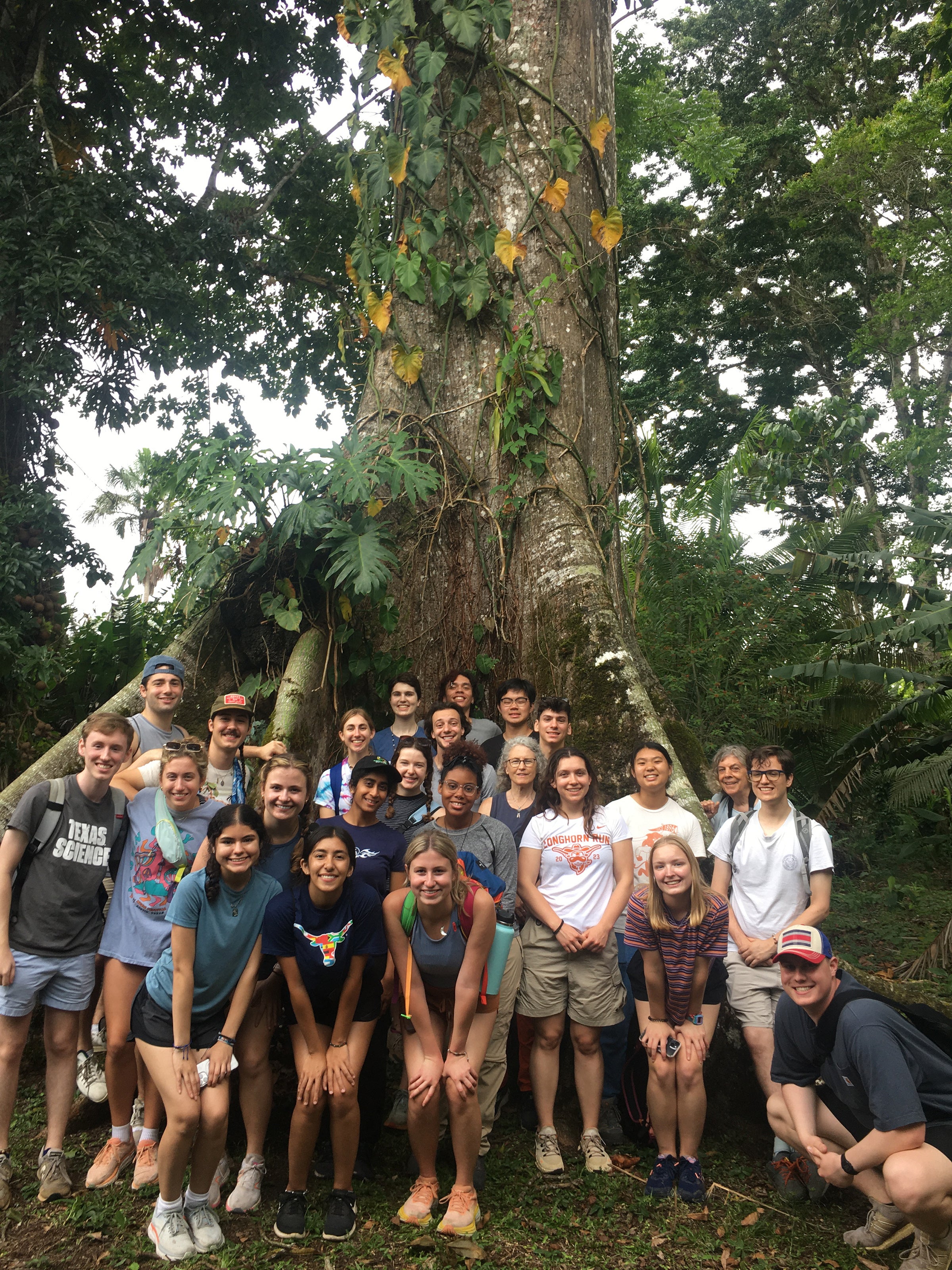
The 2023 Maymester group in front of a huge fig tree in Costa Rica.
Lesson #5: You Can Learn a Lot Outside the Classroom.
Next to her framed awards and certificates, there are several photos of her with groups of plucky students in a Costa Rican rainforest.
Over the years, she’s led seven Maymesters there with Plan II honors program students, biology majors and others. They explore how the country deals with the demands of increased tourism and efforts to increase conservation. They interview local researchers and community people and collect and analyze data for small group research projects.
It’s a place that’s special to her for other reasons. Back in the early 1970s, as a fresh young Ph.D. student, she first came to the cloud forest for a survey of insect populations. She walked through the cloud forest, with a sweep net held waist high, sampling to identify which insects were living where. It was the first time such a systematic arthropod survey had been undertaken in montane cloud forests in the New World tropics.
That early work has only grown in importance since then. In recent years, there’s been a lot of concern about insect populations falling globally. A colleague at the Monteverde Institute recognized how unique Buskirk’s original study from 50 years ago was in terms of establishing an historical baseline and asked if they could repeat her study. Now, as collaborators, they hope to answer questions about whether the bugs here are truly declining year after year and how the population changes throughout the year. The work is also spawning a range of tagalong projects.
“One new thing, they’re freezing samples so colleagues can study the DNA,” Buskirk says. “Another connection, someone is studying bird diets and bird DNA samples in the area and that syncs with this repeat study.”
It’s a beautiful bow to tie on her five decades as a scientist and (nearly as long) as a teacher.
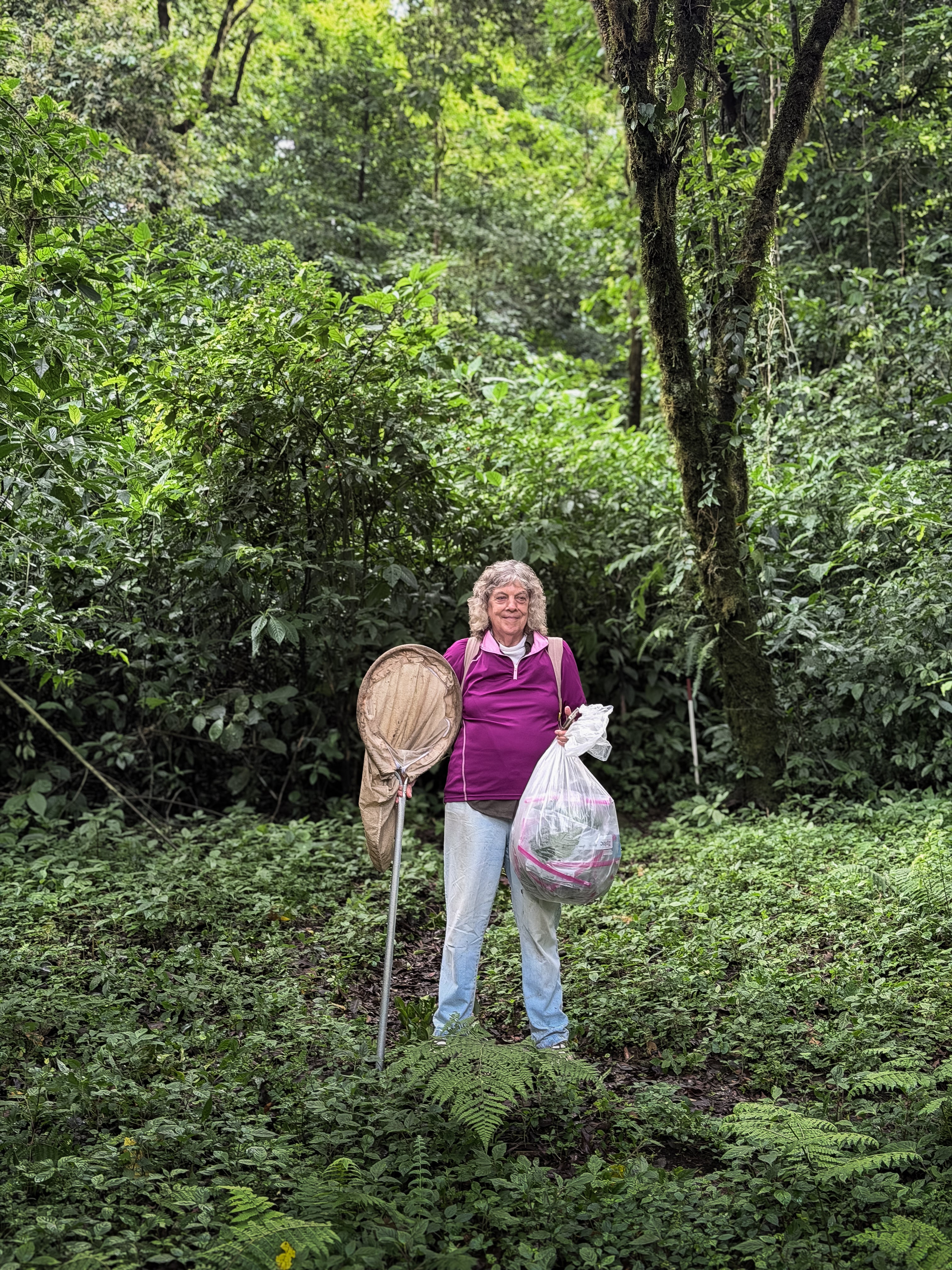
Ruth Buskirk is teaming up with colleagues in Costa Rica to repeat an insect survey that she first conducted in the 1970s. Amid growing concern about global insect declines, she’s helping document long term trends in the New World tropics.
Lesson #6: Students Often Underestimate their Own Potential.
Even though she’s retiring, she has no plans to slow down. Buskirk still has letters of recommendation to write and papers to finish on the educational impact of mini-field trips and of course, on the Costa Rican insects. She plans to travel, make art and even dust off her violin (she used to play in UT’s mariachi band back in the 1980s, “when it was very casual”).
Now it’s time for one last question. If she could travel back in time five decades, what advice would she give herself?
“When I got my Ph.D., I got it because I love the work, but I never had confidence that I would actually be on the faculty or use my degree,” she pauses. “I mean, I was wrong.”
She laughs and then continues.
“I would have said to myself, ‘You have the ability to be a professor, if that’s what you want. So work to that.’ That’s what I tell students now—take more initiative and be more assertive about opportunities in science and in teaching. In other words, recognize your strengths and be more confident with them.”
And with that, a facilities crew arrives to take away most of her furniture and she returns to sorting through her archive.
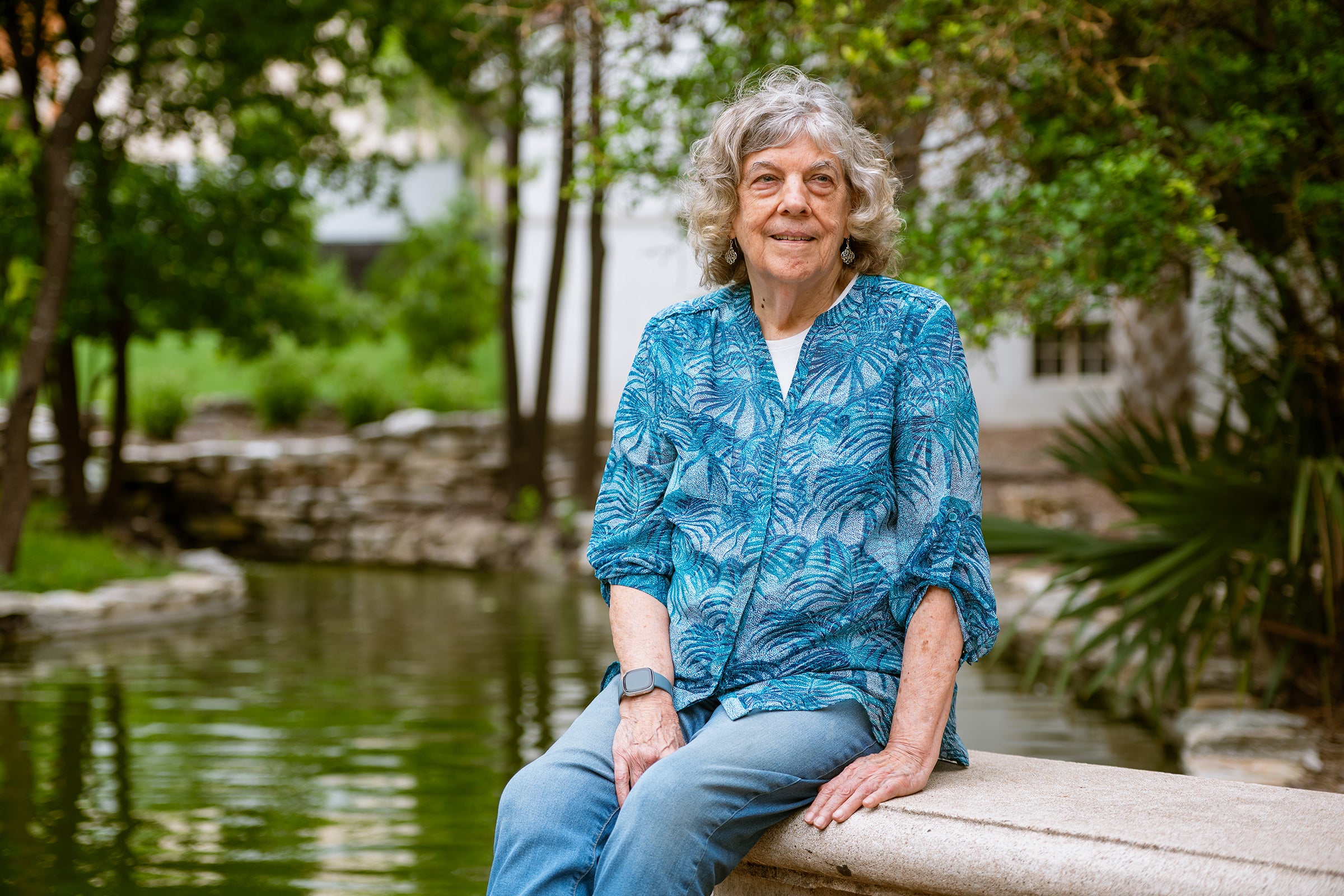
Ruth Buskirk. Photo credit: Eileen Chong.