Publishing in a Leading Journal as Undergraduates
Three undergraduate researchers published with a team in Nature, shedding new light on a microbe and its host.
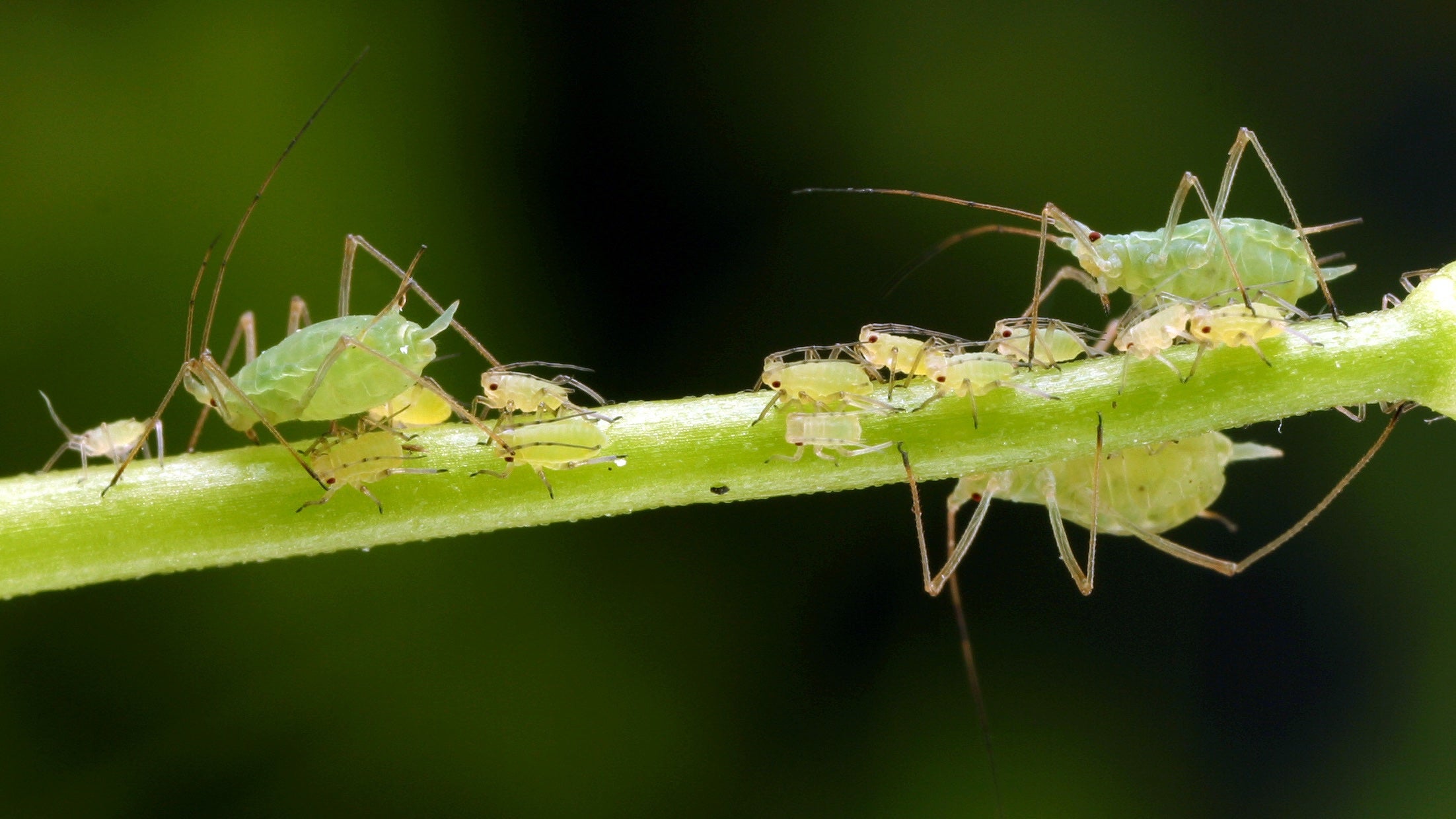
Aphids are a known agricultural pest and have a longstanding symbiotic relationship with a bacteria called Buchnera. Credit: Alex Wild
Three recent College of Natural Sciences graduates are taking bragging rights with them to medical school and the workforce, having just published in one of the world’s most highly cited scientific journals.
Recent University of Texas at Austin undergraduate researchers Ethan Yu (B.S. Biochemistry ’24), Allen Xue (B.S. Biology ’24) and Aadhunik Sundar (B.S. Biology and B.A. Plan II ’26) played key roles on a team whose paper published earlier this month in the journal Nature about a mysterious protein at the heart of a longstanding relationship between a microbe and its insect host.
Nancy Moran, the Warren J. and Viola Mae Raymer Chair of integrative biology at The University of Texas at Austin, led the study with a team that also included several Ph.D. scientists. A member of the National Academy of Sciences and once a UT undergraduate herself, Moran (B.A. Plan II ’76) is among the world’s leading authorities on symbiosis, the biological phenomenon in which two different species coexist and benefit each other over generations. Over the years, she has served as the primary investigator for a related course and lab within the Freshman Research Initiative and has often involved individual undergraduates in her research. That was the case with the work just published in Nature, where each of the three undergraduates helped bring unique skills to bear, she said.
“They weren’t just being told what to do,” Moran said. “They would look up papers and figure out what they could change that might make this work better. They would engage with the literature and find sources that helped them get results.”
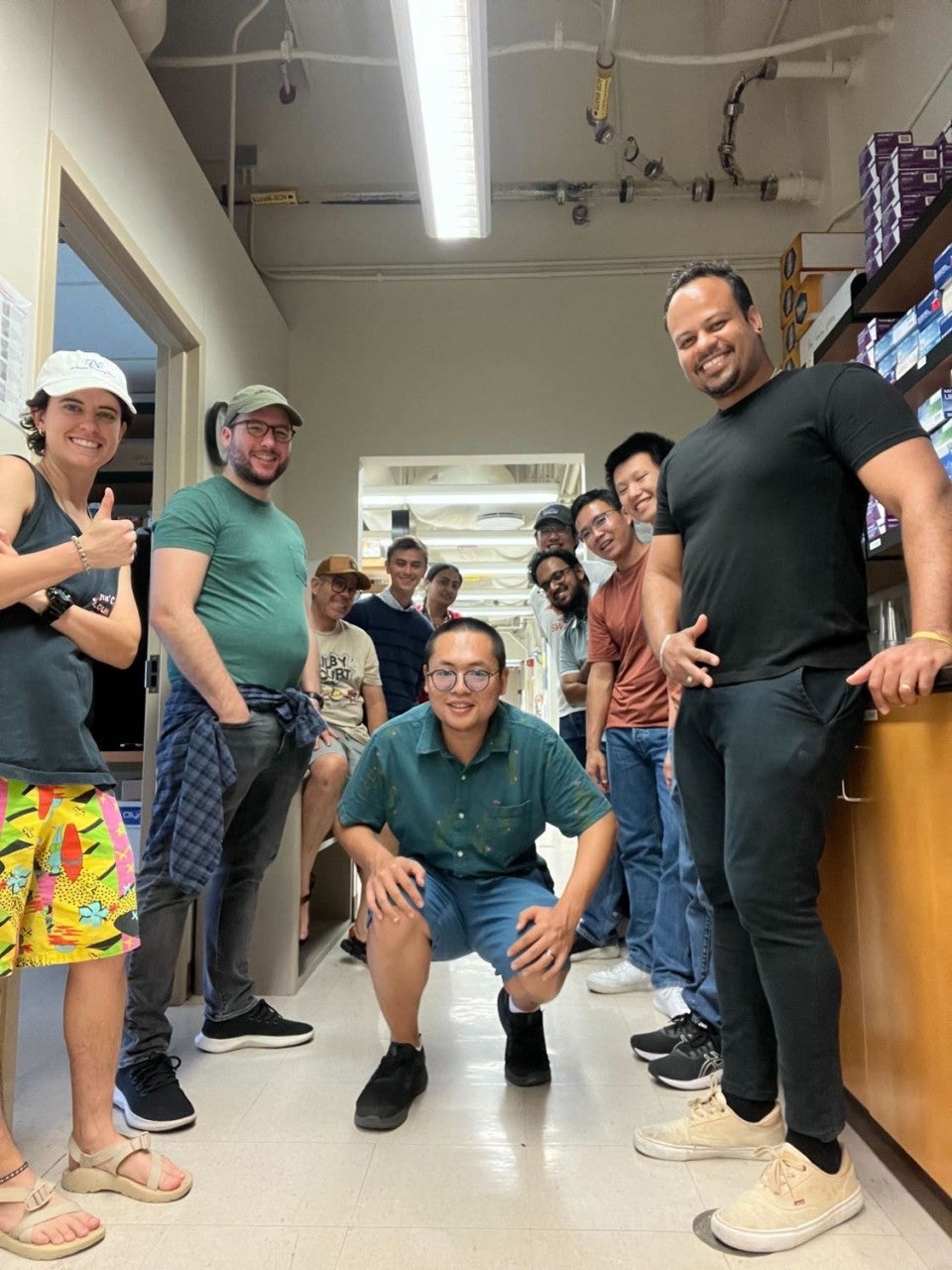
Members of Nancy Moran’s lab (L to R): Laila Phillips, PJ Lariviere, Eli Powell, Jerry Maeda, Kiran Gurang, Zheng Li (crouched in center), Ethan Yu, Hassan Uz-Zaman, Yulin Song, Allen Xue, Alan Cerquiera. Photo credit: Ethan Yu.
To better understand dynamics that are relevant to disease progression and our understanding of an agricultural pest, the Moran lab has been conducting research for years into a bacterium called Buchnera that lives inside aphids and has been doing so for more than 100 million years. For the new study, the team explored the questions: How did the first Buchnera bacteria get inside an aphid millions of years ago? And how did its descendants manage to stay there ever since?
“There had to be some kind of communication between them,” Moran said, “but all of that was just not known. It’s just kind of a mystery how the bacteria signals to the host or how it lives within a host cell.”
As an undergraduate on the project, Aadhunik Sundar learned that injecting a substance in tiny aphids is a meticulous process. He watched his own work under a microscope with a small glass pipette, manually broken to become a fine needle. Using this microinjection setup, he’d carefully position the broken pipette to inject the aphid with peptide-nucleic acid, necessary for understanding the goings-on within the microscopic microbes that lived inside the aphids (themselves only millimeters wide). He needed to do all of this without damaging the delicate insect.
The process involves much trial and error, he said, and even small changes in the needed pressure or position could affect the success of the injection.
“Because I was performing the injections and experimental setup, I felt really invested in the science,” Sundar said. “If something went wrong, it was up to me to figure out how to troubleshoot and decide what to try next.”
The hard work paid off. In the new study, he and his fellow researchers contributed to a paper concluding that — for all of the positive interactions today between these microbes and their insect hosts — it’s most likely that the relationship started with a simple infection. The team was able to identify the important role of a specific protein, called SyeA, that had been in Buchnera’s genome for millenia without anyone knowing its purpose. The fact that SyeA is secreted when it first enters embryo cells during transmission from a mother aphid to her offspring provided a critical clue.
“Our findings point to an origin as a pathogen,” Moran explained. “Buchnera started interacting with the host, entering cells using the same tricks as pathogens, but then somehow turned into a beneficial symbiont so that the host says, ‘Hey, you’re actually good for me.’”
News of the publication in Nature came as Sundar was finalizing his four years at UT. Now preparing for medical school, he credits his experience working in the lab as a major contributor to his path into microbiology and interest in studying how host-microbiome relationships shape human health, including the gut microbiome and its role in preventing or contributing to infectious disease.
“This project showed me how microbes can have powerful effects on their hosts and was a really valuable experience for me as I prepare for medical school,” he said. “I really appreciated having so much ownership over the project because it allowed me to think through a scientific problem independently.”
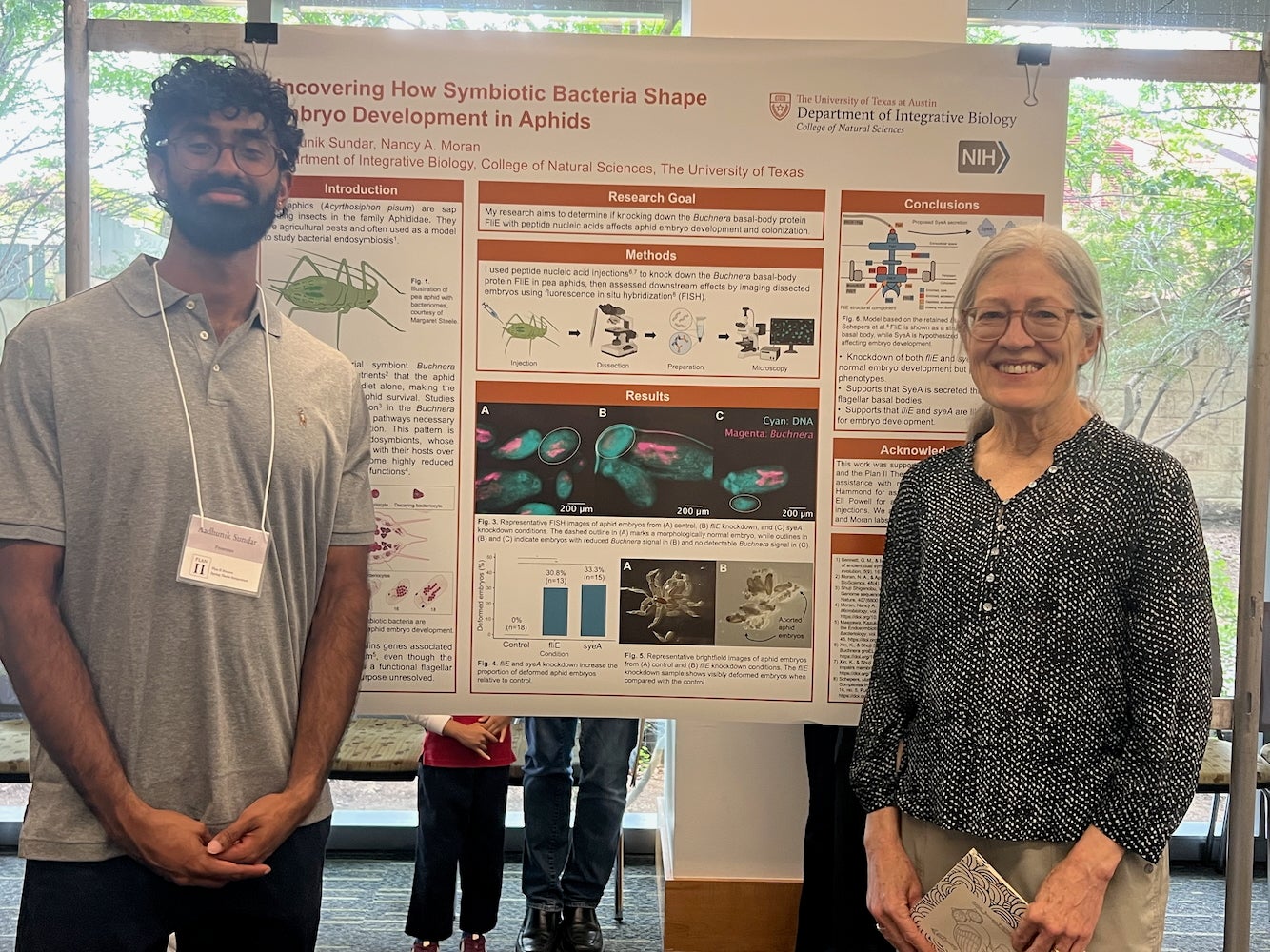
Aadhunik Sundar and Nancy Moran presenting a poster about their research on aphids and bacterial symbionts. Photo credit: Aadhunik Sundar.
Like Sundar, Xue funneled his interests in biology into a plan to attend medical school, where he is now in Florida at the University of Miami. Yu took a position with the Texas Commission on Environmental Quality in Houston after graduation. Xue and Sundar each received Undergraduate Research Fellowships through the College of Natural Sciences to help support their research, and Yu got early experience doing research as a freshman in the FRI.
“I am definitely excited for them,” Moran said. “I think they got a truly intense education on just the modern methods of biology and learned that you can really aim high and get something done, and that will serve them well.”