Experiment Sets Tightest Limits Yet on Proposed Dark Matter Particles
UT physicists involved with LUX-ZEPLIN helped analyze the largest dataset ever collected by a dark matter detector.
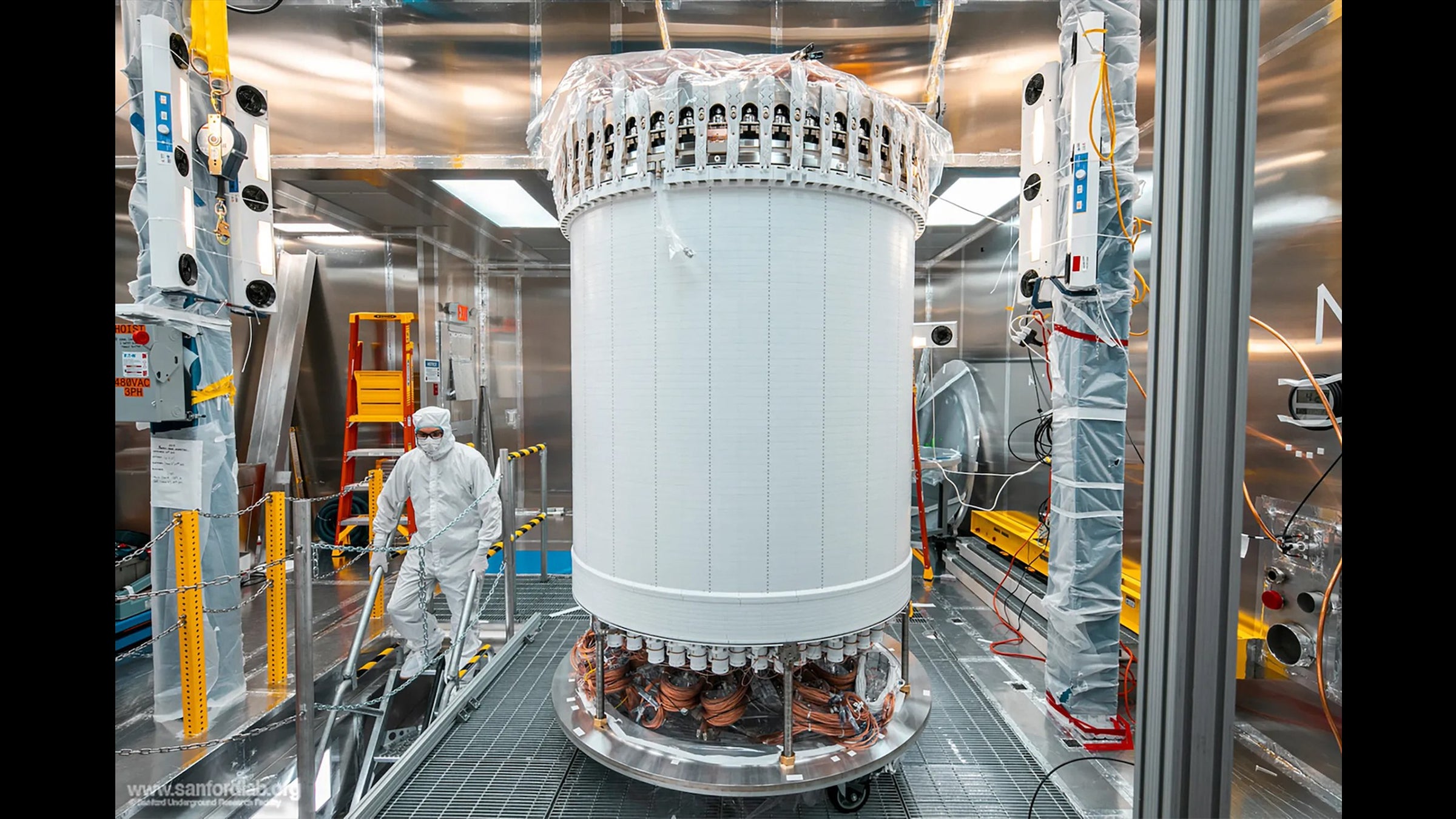
The LUX-ZEPLIN main detector in a surface lab before installation underground. Credit: Matthew Kapust/Sanford Underground Research Facility
There’s more to the universe than meets the eye. Dark matter, the invisible substance that accounts for 85% of the mass in the universe, is hiding all around us—and figuring out exactly what it is remains one of the biggest questions about how our world works. Among the prime dark matter candidates are weakly interacting massive particles, or WIMPs.
Researchers with the LUX-ZEPLIN (LZ) experiment report today that they have found no sign of WIMPs, despite having looked for the first time at masses equivalent to no more than a few protons. LZ is an international collaboration of 250 researchers from 37 institutions, including UT Austin, all hunting for galactic dark matter with a detector, nearly a mile below ground, that’s managed and funded in part by the U.S. Department of Energy’s Lawrence Berkeley National Laboratory.
Presented today in a scientific talk at the Sanford Underground Research Facility in South Dakota, the results further narrow down possibilities of what dark matter might be and how it might interact with ordinary matter.
The newest results also mark the first time LZ has picked up signals from neutrinos from the sun, a milestone in sensitivity.
“This result is clear confirmation that LZ could observe even low-mass dark matter,” said Scott Kravitz, assistant professor at The University of Texas at Austin and the analysis coordinator for LZ. “It’s particularly powerful to look at something fully out of our control—nuclear fusion from the sun—and find that the predicted rate of events from that process is consistent with our observations. It means the detector and our experiment are as sensitive as expected, and capable of finding dark matter if it’s within the range where we’re searching.”
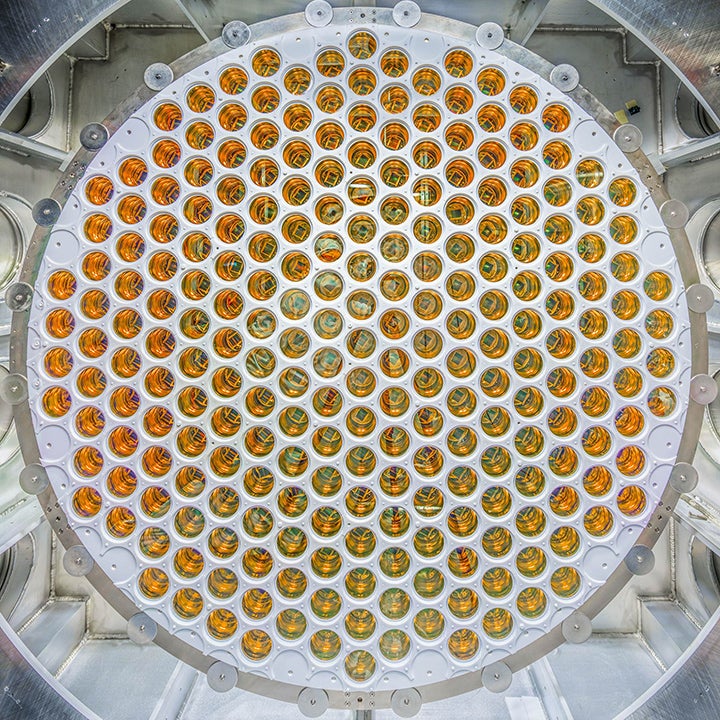
Photomultiplier tubes inside the LZ detector are designed to capture faint flashes of light that could signal a dark matter interaction. Credit: Matthew Kapust/Sanford Underground Research Facility.
The new results, based on 417 live days of data that were taken from March 2023 to April 2025, use the largest dataset ever collected by a dark matter detector and have unmatched sensitivity.
“We have been able to further increase the incredible sensitivity of the LUX-ZEPLIN detector with this new run and extended analysis,” said Rick Gaitskell, a professor at Brown University and the spokesperson for LZ. “While we don’t see any direct evidence of dark matter events at this time, our detector continues to perform well, and we will continue to push its sensitivity to explore new models of dark matter. As with so much of science, it can take many deliberate steps before you reach a discovery, and it’s remarkable to realize how far we’ve come. Our latest detector is over 3 million times more sensitive than the ones I used when I started working in this field.”
Dark matter has never been directly detected, but its gravitational influence shapes how galaxies form and stay together; without it, the universe as we know it wouldn’t exist. Because dark matter doesn’t emit, absorb or reflect light, researchers have to find a different way to “see” it.
LZ uses more than 11 tons of ultrapure, ultracold liquid xenon. If a WIMP hits a xenon nucleus, it deposits energy, causing the xenon to recoil and emit light and electrons that the sensors record. Deep underground, the detector is shielded from cosmic rays and built from low-radioactivity materials, with multiple layers to block (or account for) other particle interactions—letting the rare dark matter interactions stand out.
LZ’s extreme sensitivity, designed to hunt dark matter, now also allows it to detect neutrinos—fundamental, nearly massless particles that are notoriously hard to catch—in a new way. The background signal of neutrinos from the sun (what scientists call “the neutrino fog”) presents challenges for the detector’s ability to detect dark matter at low masses (3 to 9 gigaelectronvolts/c2). Nonetheless, the detector’s new secondary role as a solar neutrino observatory gives theorists more information for their models of neutrinos, which still hold many mysteries themselves.
LZ is supported by the U.S. Department of Energy’s Office of Science, Office of High Energy Physics and National Energy Research Scientific Computing Center. LZ is also supported by the Science & Technology Facilities Council of the United Kingdom; the Portuguese Foundation for Science and Technology; the Swiss National Science Foundation; the Australian Research Council Centre of Excellence for Dark Matter Particle Physics; and the Institute for Basic Science, Korea.
Adapted from a press release from Lawrence Berkeley National Laboratory.
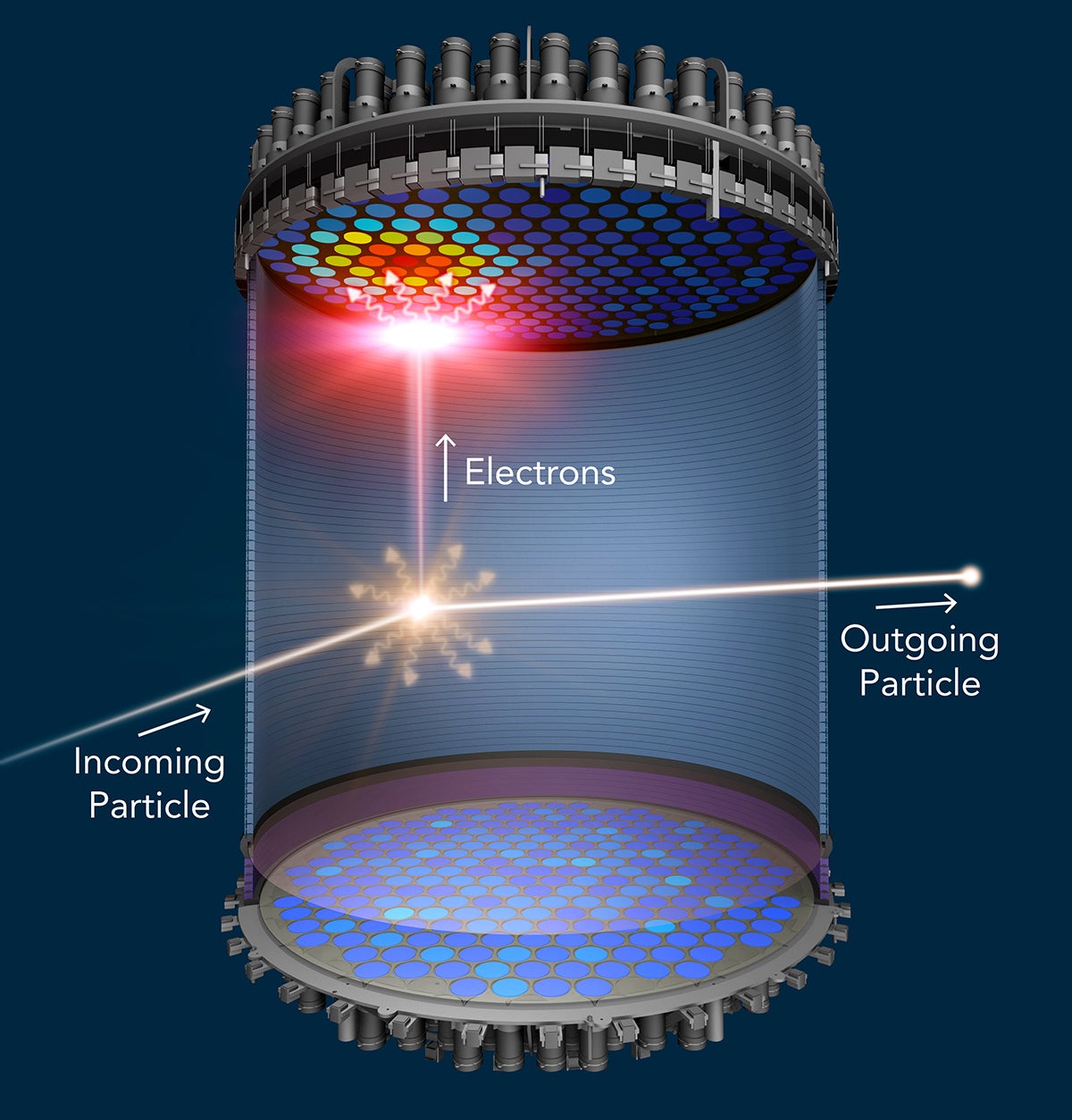
When a WIMP (or neutrino) collides with a xenon atom, the xenon atom emits a flash of light and electrons. The light is detected at the top and bottom of the liquid xenon chamber. An electric field pushes the electrons to the top of the chamber, where they generate a second flash of light. Credit: Greg Stewart, SLAC National Accelerator Laboratory