AI Tips Off Scientists to New Drug Target to Fight Monkeypox Virus
The breakthrough could be used in a new vaccine or antibody therapy to fight mpox, the disease caused by the monkeypox virus.
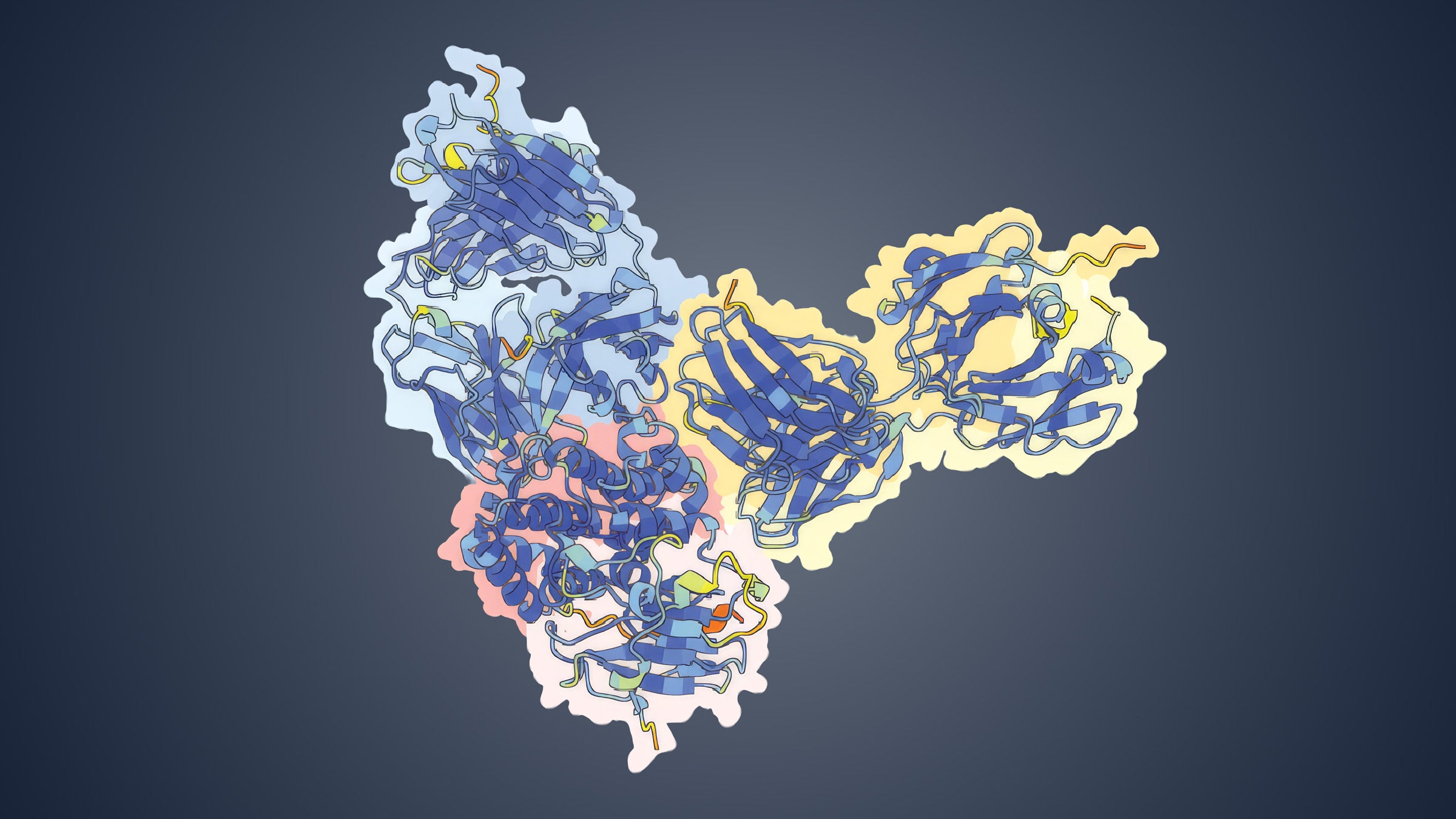
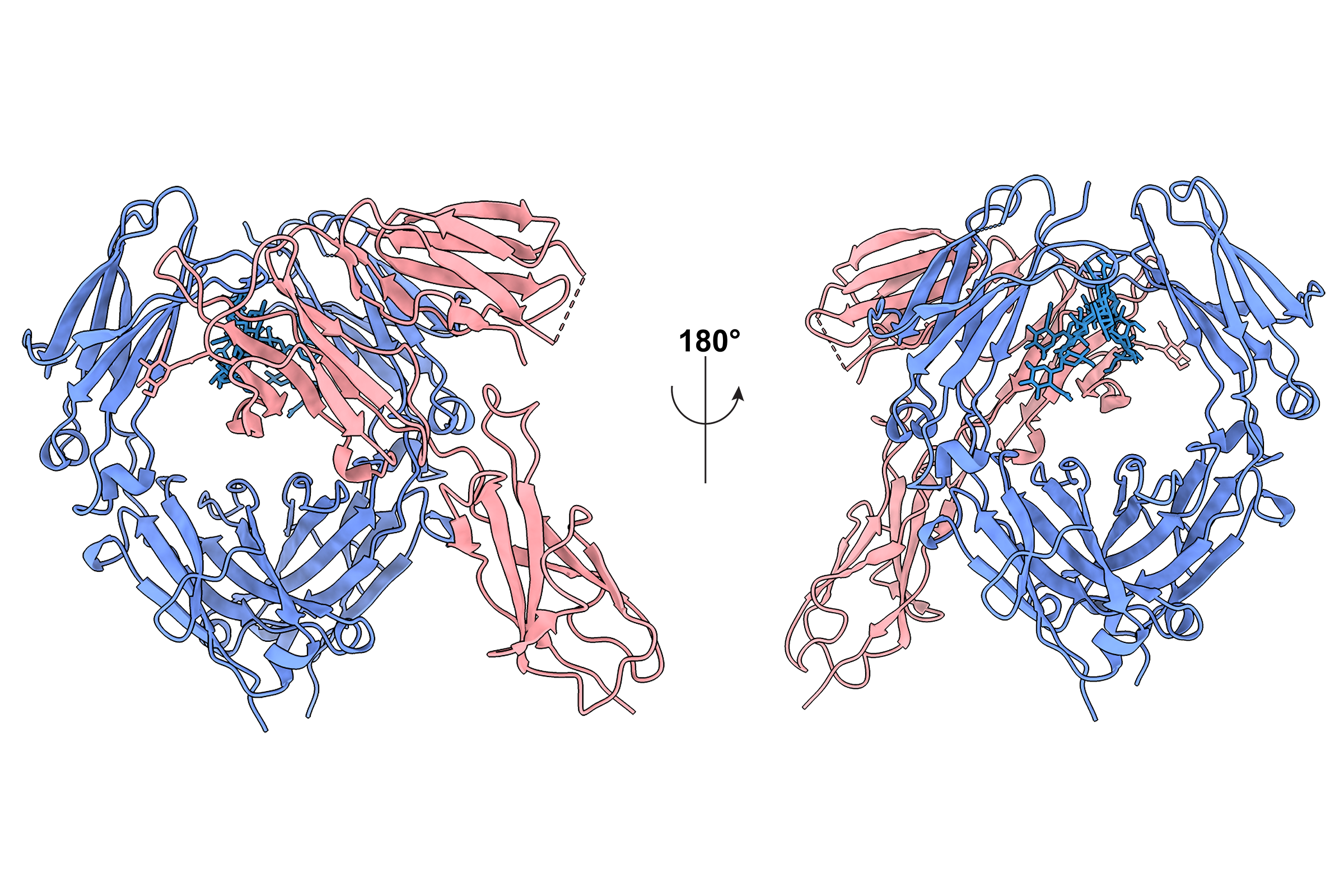
Structure of a surface protein on the monkeypox virus (MPXV OPG153, highlighted in pink) in complex with two neutralizing antibodies: 08E11 (highlighted in blue) and 12I12 (highlighted in yellow). Credit: University of Texas at Austin.
With the help of artificial intelligence, an international team of researchers has made the first major inroad to date towards a new and more effective way to fight the monkeypox virus (MPXV), which causes a painful and sometimes deadly disease that can be especially dangerous for children, pregnant women and immunocompromised people.
Reporting in the journal Science Translational Medicine, the team found that when mice were injected with a viral surface protein recommended by AI, the animals produced antibodies that neutralized MPXV, suggesting the breakthrough could be used in a new vaccine or antibody therapy to fight mpox, the disease caused by MPXV.
Using the blood of patients who had been previously infected with the virus or vaccinated against it, researchers in Italy helped identify 12 antibodies that effectively neutralize MPXV but did not know what parts of the virus they targeted. A team of researchers at The University of Texas at Austin used AI to successfully predict which of the roughly 35 proteins on the surface of the virus the antibodies strongly bind to.
“It would have taken years to find this target without AI,” said Jason McLellan, a professor of molecular biosciences at UT and co-lead author of the study. McLellan, the Robert A. Welch Chair in Chemistry and one of the leaders of Texas Biologics, a research group at UT working to develop new drugs and other medical advances. “It was really exciting because no one had ever considered this protein before for vaccine or antibody development. It had never been shown to be a target of neutralizing antibodies.”
In 2022, mpox began to spread around the world, causing flulike symptoms and painful rashes and lesions for more than 150,000 people, while causing almost 500 deaths. Vaccines developed to fight smallpox were repurposed amid the outbreak to help the most vulnerable patients, but that vaccine is complicated and costly, due to its manufacture from a whole, weakened virus.
MPXV is closely related to the virus that causes smallpox, so this discovery could potentially lead to better vaccines or therapies for smallpox, which poses a high risk as a bioterrorism weapon, given its easy transmission and high death rates.
The team is now working to develop versions of the vaccine antigen and antibodies that are more effective at fighting disease while cheaper and easier to produce than existing versions that use a weakened version of a closely related poxvirus. Ultimately, the researchers hope to test vaccine antigens and antibody therapies to protect against mpox and smallpox in people. McLellan calls the approach used in this study “reverse vaccinology.”
“We started with people who survived infection with monkeypox virus, isolated antibodies that they naturally produced and worked backward to find what part of the virus acted as the antigen for those antibodies. Then we engineered the antigen to elicit similar antibodies in mice,” McLellan said. “Unlike a whole-virus vaccine that’s big and complicated to produce, our innovation is just a single protein that’s easy to make.”
MPXV has dozens of different proteins on its surface. The scientists knew at least one of these surface proteins was critical to spread infection, and that it could be blocked by some of the newly identified antibodies. But which ones? They needed to find the right match—between surface protein and antibody—for any new drug or tool to help seed prevention of the infection, known as an antigen.
McLellan and his lab at UT used the AlphaFold 3 AI model to predict which of the roughly 35 proteins on the surface of the virus the antibodies strongly bind to. The model predicted with high confidence that some antibodies would bind to a viral surface protein called OPG153, and follow-up work verified the result. This suggested that the protein would be a good target for developing new antibody therapies to treat mpox or for use in a vaccine to coax a person’s immune system to fight the virus.
UT Austin has filed a patent application on the use of OPG153 (and its derivatives) as a vaccine antigen. The Fondazione Biotecnopolo di Siena filed a patent application on antibodies that target OPG153.
The other UT Austin co-authors are Emily Rundlet, Ling Zhou and Connor Mullins. The study’s authors in Italy, who helped identify the original group of antibodies, are Rino Rappuoli and Emanuele Andreano at the Fondazione Biotecnopolo di Siena.
This work was funded in part by the Welch Foundation.