A Formula for Promoting Student STEM Success
James Álvarez is a new college administrator and alum overseeing work to create effective pathways into STEM.
Every year, countless school children, teens and college students around the U.S. do better in math, science and technology topics because of efforts rooted in part in the College of Natural Sciences. From the teacher-training focused UTeach initiative in 22 states to the college-transition program called Launch Years, a project of the college’s Charles A. Dana Center, now in 27 states plus Washington D.C., CNS-affiliated education initiatives are far-reaching and deliver lasting impact.
A sizable segment of this work, which involves children as young as preschool and learners as old as adults, puts one subject front and center: math.
“Mathematics is the most precise, consistent way humans have found to describe how reality behaves, from galaxies to genes to Google,” said Afi Wiggins, the Dana Center’s managing director, recently. “When our education systems provide opportunities for individuals to deeply understand mathematics as the language of the universe, we unlock endless possibilities.”
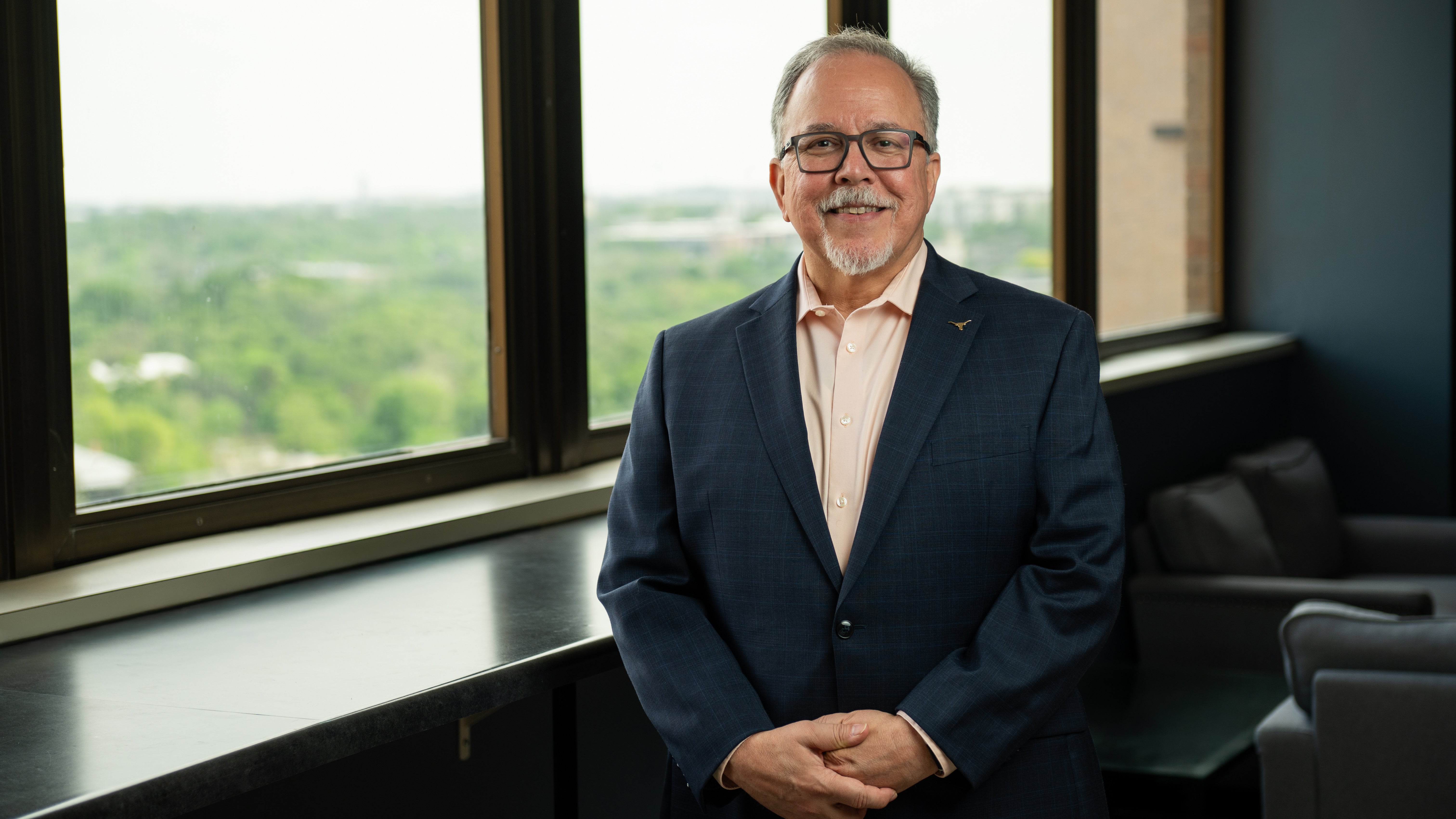
Earlier this year, the College of Natural Sciences welcomed a mathematician and past Dana Center researcher to the faculty and the college’s leadership team as the first associate dean for P-20 education initiatives. James Álvarez (Ph.D. Mathematics ’96) is working to bolster programs across the college that support STEM education not just at UT, but across the country and at every level. Before returning to his alma mater, he was a professor of mathematics at UT Arlington and program director of the National Science Foundation’s Division of Undergraduate Education.
We sat down with Álvarez to hear about what he has learned over the years about student success in STEM and what it may mean for helping more people lead rich, contributing lives down the road.
You’ve worked for many years to improve STEM education, as a professor and through different organizations, including where you did your postdoctoral research, here at UT’s Dana Center. Are there any overarching themes or key takeaways that have been a throughline in this work for you?
As early as the times when I was a graduate student, I realized that I had previously been in learning environments in which I could have been asked to do more. That made me think about what I can do to leverage what I’ve learned so that either the policy, structures or expectations for students from K-12 through college could be designed in a way that students are being asked to think at a level that is productive in mathematics.
Students come to the university to major in STEM because they want to be engineers, scientists and mathematicians, and their academic identity is important. It’s important to foster that through giving them challenging work, but then also encouraging them to work as a community and in groups, which research shows promotes success.
Not only do we want to offer deep learning experiences for students once they get to college, we want to offer the same things for prospective teachers, so that they take that back to the classroom. My colleagues and I recently produced a volume published by the Mathematical Association of America called “An Aspirational Approach to the Mathematical Education of Teachers.” It describes our work in developing innovative experiences in various mathematics courses taken by prospective teachers.
How does learning science and math help students to be successful after college, even if they don’t go into STEM?
Students need to be able to take a problem that they haven’t seen before and think critically on how to break it apart. There’s a certain level of persistence required in being able to keep asking questions and keep working at something. The problems in the real world don’t have obvious solutions, and we need to do our best to figure out how to frame the problems right and how to then move forward in solving them.
Unless you encounter projects in your education that require you to do that, then it’s more difficult to develop those skills that allow you to persist. We need students to know that just because you can’t see a solution right away, that doesn’t mean that one doesn’t exist. Being able to think critically and go forward is what’s really important, and that’s what effectively learning math and science teaches you to do.
What are some of the exciting ways you see UT’s work in STEM education growing and evolving over the next few years?
The increasing importance of data literacy, robust quantitative reasoning and the ubiquity of AI provide opportunities. We can and should be leading innovation in STEM education that addresses these emerging trends and workforce needs. We especially can leverage the powerful national work in mathematics pathways by the Dana Center and the transformative work in, and national model for, STEM teacher preparation by UTeach.
In your own work teaching, what’s your philosophy about creating a culture conducive to learning?
I believe that connection means a lot. Bringing humanity into our teaching really does impact how students think about your course or the subject that they’re learning. To that end, I try to always recognize contributions in my classroom, so when students do something well or come up with a contribution that’s valuable, let’s recognize that. For the student, that’s very empowering. I learn students’ names and about their major or goals in life because I think the human aspect of learning is really important.
What do you say to people who claim that they “aren’t math people”?
As someone who enjoys seeing patterns and structure and recognizing when we can use the power of mathematics to solve problems, when someone says they’re not a math person, I think it’s because they just didn’t have the right learning experiences. It may be that you didn’t have the right teachers, and that brings me back to the importance of teachers.
I think that in many ways, everyone is a math person. It’s not an exclusive club. Many times people haven’t thought of math as recognizing patterns, so they may actually be practicing those habits of mind and not even realizing that those habits would enable them to engage meaningfully with mathematics.