Fusion Energy Seed Grants Launch New Interdisciplinary Collaborations at University of Texas at Austin
The projects bridge physics, engineering and computational sciences to tackle big challenges for fusion energy.
Fusion energy is having a moment – and a longstanding, fusion-focused institute at The University of Texas at Austin stands ready to meet that moment head on.
In the three and a half years since scientists at the Lawrence Livermore National Laboratory first achieved fusion ignition, there have been a lot of developments.
- Last year, the private sector alone invested $2.6 billion in fusion energy research and development, a number that’s projected to grow significantly this year. Several private companies are now racing to build demonstration reactors, and a recent survey of fusion energy companies found that 71% believe the first fusion power plant will deliver commercial electricity by 2040.
- The U.S. Department of Energy (DOE) is investing in research through various initiatives, including its Fusion Innovation Research Engine (FIRE) Collaboratives, two of which include researchers in The University of Texas at Austin’s Institute for Fusion Studies.
- The DOE has also launched the Genesis Mission, which among other things, provides support to universities, national labs and industry to apply artificial intelligence to accelerate the commercialization of fusion, including with one of its first awarded projects, just announced in July, a collaboration involving UT’s Oden Institute for Computational Science and Engineering and Sandia National Laboratories.
To keep UT Austin at the forefront of this booming field, Diego del-Castillo-Negrete, director of the Institute for Fusion Studies (IFS), created a seed funding program to build bridges between the physicists in the institute and experts in the Oden Institute and Cockrell School of Engineering. Funding is provided by all three units. Four of these awards—each involving a principal investigator in either Oden or Cockrell and a second PI at IFS—were recently awarded and will support four graduate students for two years as they conduct interdisciplinary research.
Bringing engineers and experts in other fields accustomed to applying numerical methods to a wide range of problems outside of fusion reactors to one of the trickiest problems in all of physics will benefit researchers across domains. Physicists will get to use new numerical methods, as engineers get to tackle problems in domains they haven’t worked on yet.
“Bringing together teams with complementary expertise, from plasma physics and from engineering, will allow us to make an impact in a way that these two different groups could never dream of alone,” said UT physicist David Hatch.
The new collaborations will also address a key pain point for the fusion energy industry: workforce development. Private companies need to find enough talented, creative thinkers to overcome the myriad challenges of getting a highly complex new source of energy into the world.
“If we’re successful with these grants, these four graduate students will find and maintain an interest in fusion research, get Ph.D.s related to this work, publish papers and gain experience that will carry them on into industry or academia,” del-Castillo-Negrete said.
Aligning well with DOE’s focus on AI in fusion energy, three of the four newly funded collaborations involve taking big, complex computer simulations that require a tremendous amount of time and energy to run and replacing them with far more efficient AI models that have been trained on the data produced by their beefier predecessors. The goal with each of these surrogate AI models is to produce just as accurate results, but at a fraction of the cost and time. Building partnerships to last is another core goal.
“The most exciting aspect for me is actually the prospect of having it balloon into a larger collaboration with another research group,” said Josh Burby, assistant professor of physics, one of the co-PIs on a new seed grant. “You know, it’s not always easy to build bridges with other faculty because everyone is so busy. I’m really excited that this will be a very structured and mutually beneficial way of building one of those bridges.”
Read more about the four new projects below.
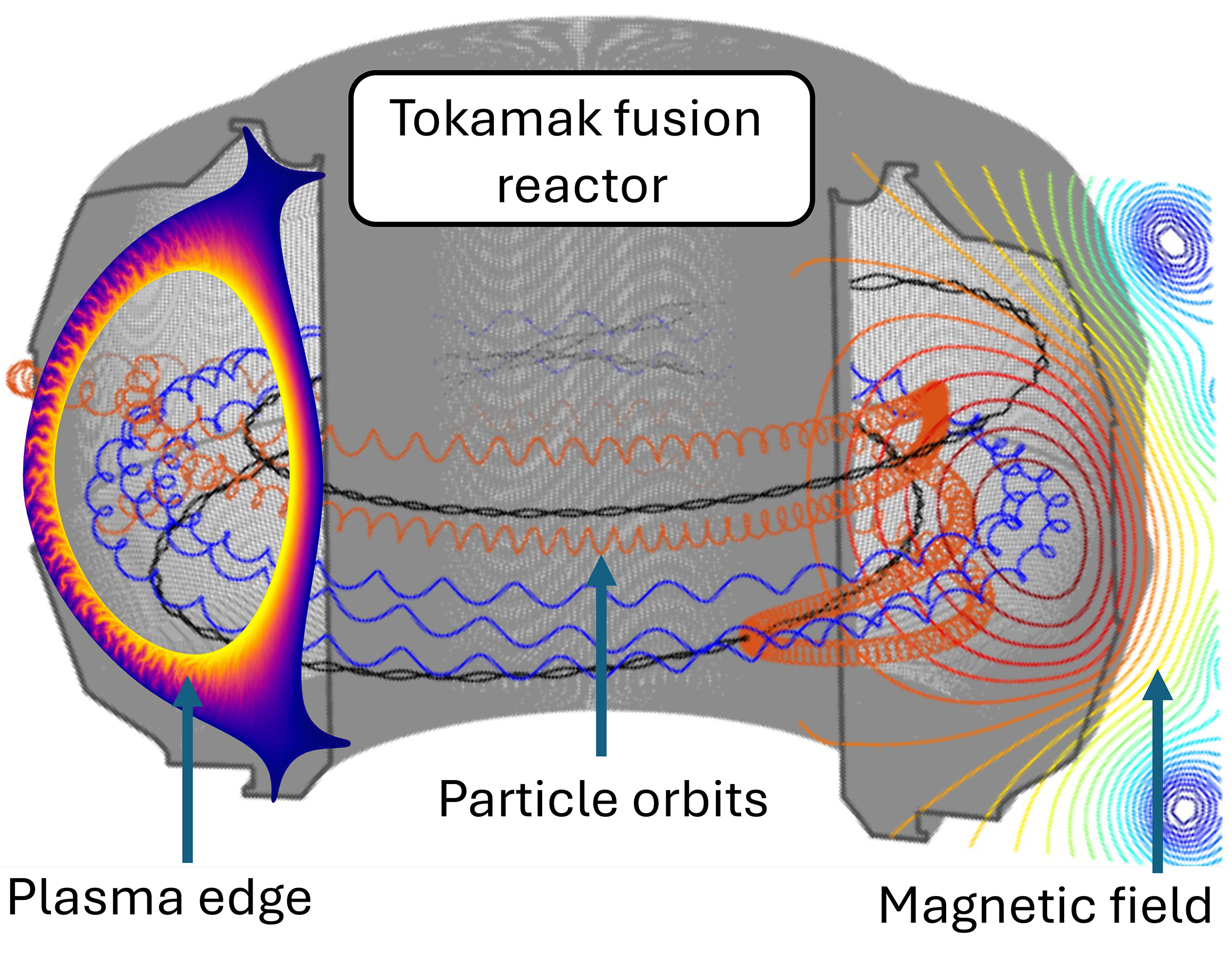
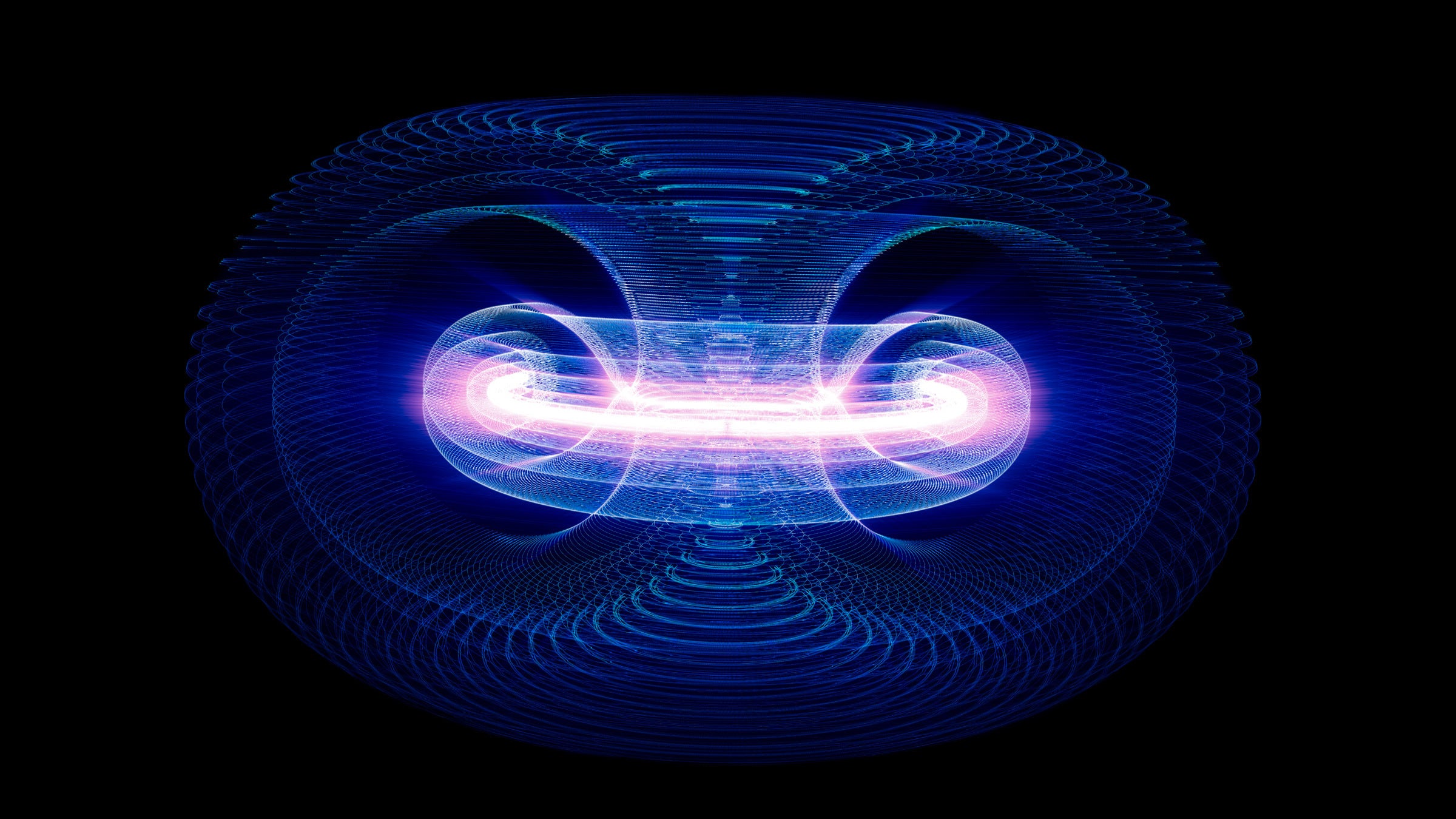
Illustration of a tokamak fusion reactor highlighting three aspects targeted in these seed grant projects: (i) the plasma edge; (ii) the magnetic field (that will be tweaked to control the plasma) and (iii) traces of particle orbits (e.g., the alpha particles mentioned in Josh Burby's project that need to be modeled to make sure they stay confined).
Under Control
Problem: A tokamak fusion reactor is like a set of Russian nesting dolls—a donut-shaped plasma floats inside a larger, donut-shaped vessel, trapped by a donut-shaped magnetic field. To avoid damaging the container, the plasma has to maintain this exact shape and alignment. But a host of different kinds of instabilities can easily creep in, for example causing the plasma to drift away from the center line or making the surface wavy, instead of smooth. These instabilities can increase interactions between the plasma and the inner wall of the container or other components leading to loss of confinement.
Solution: Develop a kind of digital twin of the plasma, based on indirect sparse measurements, that tells you it’s 3D shape, alignment and other properties in real time. And then use that digital twin to continuously tweak the knobs of a second set of magnetic coils to help keep the plasma well behaved. (Note: The Genesis Mission project, involving Oden Institute director Karen Wilcox, is applying digital twins to the components inside the fusion energy reactor, from design through years of service, so those parts can be built and trusted to survive extreme heat, radiation and chemical stress.)
The Team’s Plan: Diego Del-Castillo-Negrete (IFS), Omar Ghattas (Oden Institute/Cockrell School) and Aaron West (graduate student in the Computational Science, Engineering, and Mathematics interdisciplinary program) plan to use a computationally expensive, yet high fidelity simulation to generate a set of training data for a surrogate AI model that’s fast and accurate. This then can serve as a digital twin that provides real time control optimization.
What Could Come Next: The researchers aim to build a real time control optimization system that is faster and more accurate than state-of-the-art systems like the one announced by Google’s DeepMind group in 2022. Eventually, they hope to test their model in a working fusion reactor, like the Variable Configuration Tokamak (TCV) in Lausanne, Switzerland or the DIII-D tokamak at General Atomics in San Diego.
“Machine-learning methods recently applied to plasma control, such as reinforcement learning, have demonstrated impressive capabilities, but they can require large amounts of simulated training data and offer limited guarantees,” del-Castillo-Negrete said. “Our project with Omar’s team brings together unique expertise in physics-constrained optimization, adjoint methods, uncertainty quantification, and real-time neural-operator surrogates—a potentially transformative combination for fast, reliable fusion plasma control.”
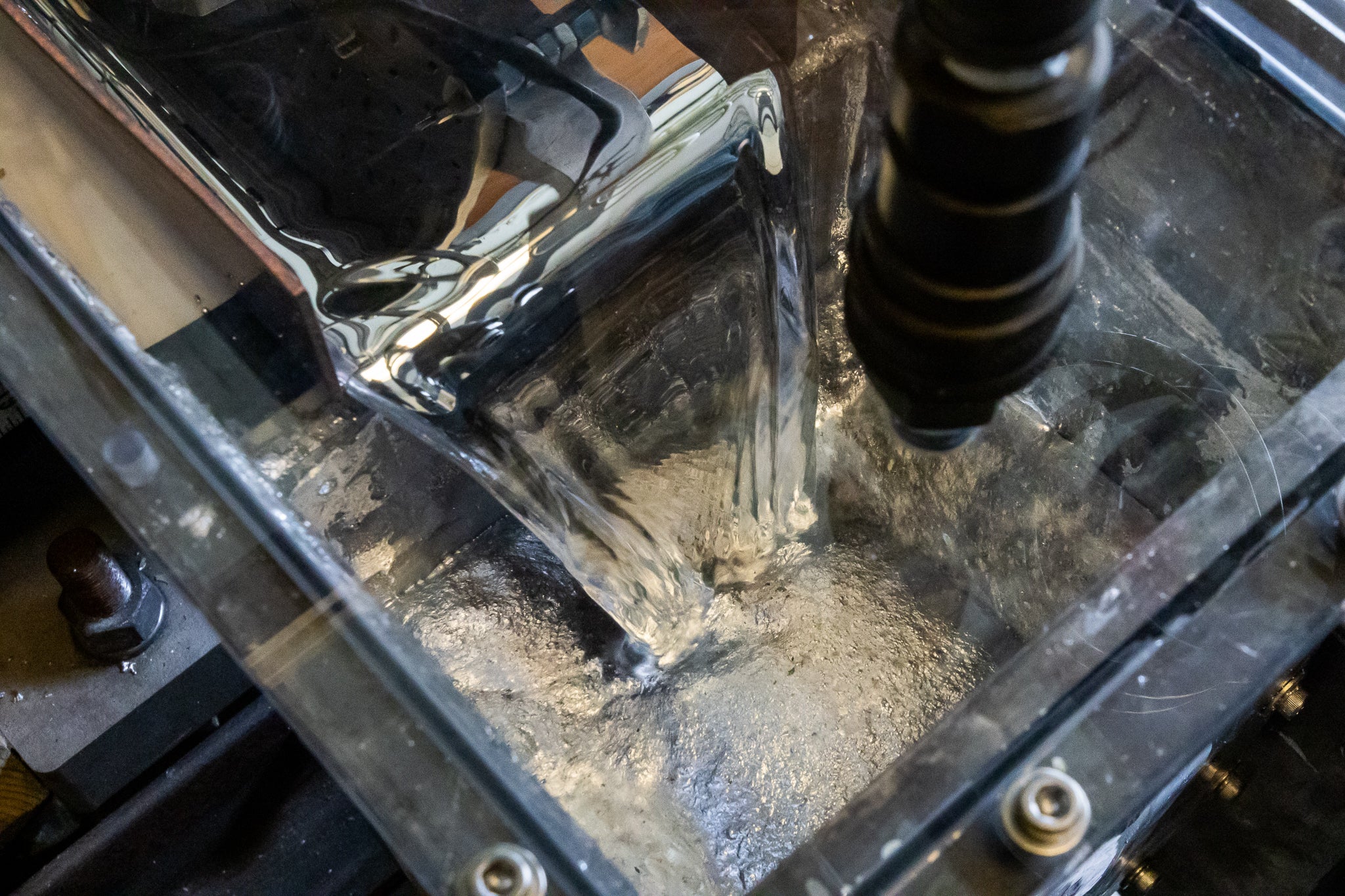
Scientists are experimenting with various ways of using liquid metals to cool excess heat from fusing plasma. Shown here is a stream of liquid metal alloy. Credit: Michael Livingston/Princeton Plasma Physics Laboratory.
Liquid Metal Alloys
Problem: The plasma inside a fusion reactor generates so much heat, radiation and high energy particles that it can potentially destroy the surrounding walls and other plasma-facing components. One possible solution is to build them out of “liquid metals”—such as lithium, indium, gallium or tin—that can be continuously recycled to replenish the surface. But there’s a catch: no pure liquid metal has all the properties that are desirable for a fusion reactor.
Solution: A potential alternative would be an alloy of a liquid metal with other materials that would have a better mix of properties than any individual liquid metal. This idea builds on concepts that were first developed at UT Austin and led to a spin-off company that’s exploring liquid metals for fusion reactors, called ExoFusion.
The Team’s Plan: David Hatch (IFS), Narayana Aluru (Oden Institute/Cockrell School), Yuanyue Liu (Oden Institute/Cockrell School), and Md Rashidul Alam (Cockrell School graduate student) will work to find candidate alloys by running big computer simulations. They aim to learn what happens to liquid metal alloys in contact with a plasma for extremely short time periods (10s of picoseconds) and then use that data to train machine learning models that can then simulate these alloys at much longer timescales, but using far fewer computing resources than a traditional simulation.
What Could Come Next: Once the researchers identify strong candidates, they have multiple partnerships to test them in real world experiments funded by the DOE, including at Penn State and at a soon-to-be-online fusion platform at Princeton University, called NSTX-U.
“One of the most compelling aspects of this project is that it’s coming at just the right time to test our candidate alloys out in a real fusion environment,” Hatch said.
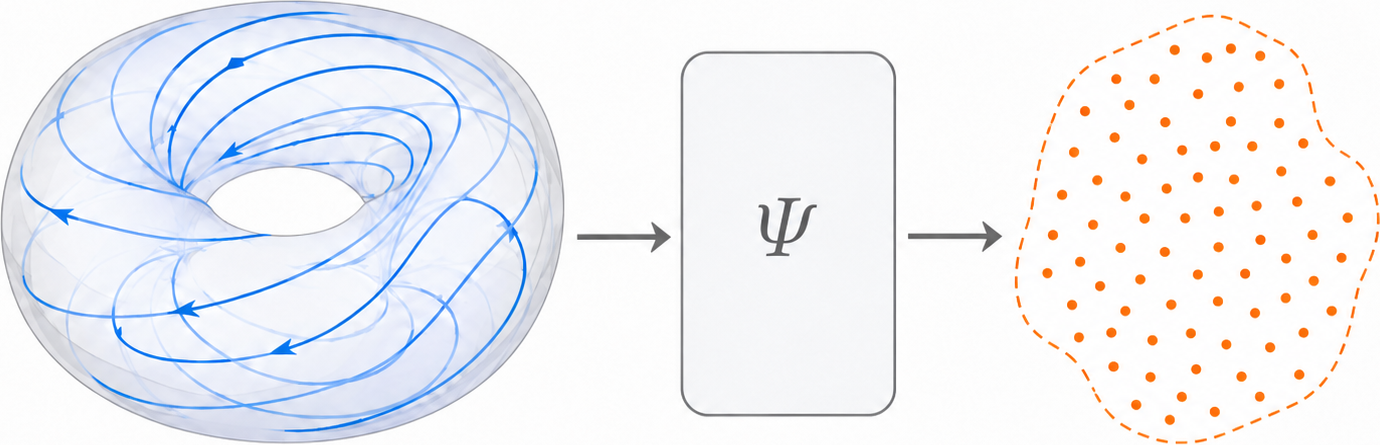
In the project related to plugging “magnetic bottles”, an AI model (center) will be trained to ingest a candidate magnetic field configuration (left) and return the distribution of fusion-born alpha particles after they’ve had time to escape (right). This will allow scientists to rapidly assess the size of leaks in the magnetic bottle, hopefully faster than any previous method. Credit: Nicholas Nelsen.
Plugging Magnetic Bottles
Problem: When high-energy alpha particles leak from a fusion reactor, it prevents the plasma from getting hot and dense enough to sustain fusion. To prevent them from leaking, engineers design elaborate magnetic confinement systems, or “magnetic bottles,” but there are often holes in the magnetic field. In the design phase, they can run simulations to track thousands to millions of alpha particles moving through the device to determine where they tend to leak out and how quickly, allowing them to tweak the design. But it’s slow, takes a lot of computing power and requires many iterations to optimize a design.
Solution: Advances in artificial intelligence could very well help designers explore potential designs faster and more accurately than previously possible.
The Team’s Plan: Josh Burby (IFS), Nicholas Nelsen (Oden Institute & Cockrell School) and Matthew Meeker (Oden Institute graduate student) plan to train a surrogate AI model to track these particle trajectories more efficiently than the state-of-the-art model, perhaps 10 to 100 times faster.
What Could Come Next: “Right now, where people might either not do these alpha particle calculations during design, or maybe they’ll use them for finetuning a design late in the process, our hope is that these machine learning-based tools we develop will allow people to confidently include these alpha particle calculations in all of their design optimizations without worrying about how much it’s going to slow down the process,” Burby said. “The thing that I’m most excited about technically is that if we can demonstrate a significant speed-up on this aspect of the problem, then we should have a very good shot at enticing private fusion companies to use our methods and even partner with us.”
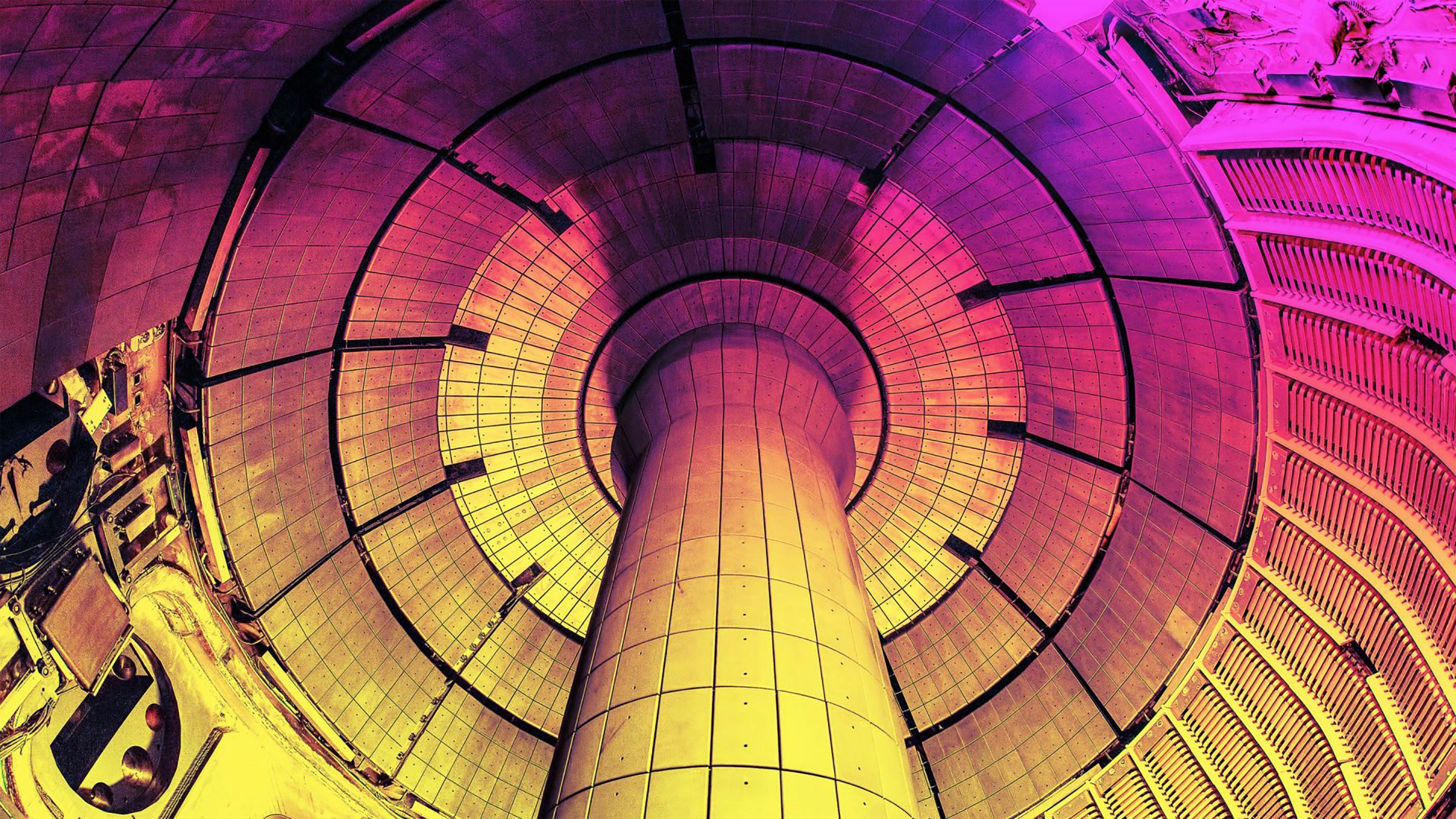
A colorized photograph of the inside of NSTX-U, an experimental fusion reactor that could be used to test liquid metal alloys identified by UT Austin. Credit: Princeton Plasma Physics Laboratory.
Living on the Edge
Problem: Inside a fusion reactor, some designs have a feature called a divertor—which functions somewhat like the exhaust on a car—it’s where excess heat and high energy particles are funneled away or “scraped off.” To design a working fusion reactor, you need a high-fidelity computer simulation of how the scrape-off layer behaves, but the scrape-off layer (or SOL, meaning the outer edge of the plasma) is much more complex and challenging to simulate than the core of the plasma. State-of-the-art simulations are accurate, but slow and costly in terms of computing resources.
Solution: Take advantage of numerical techniques that are new, at least in this setting, to develop a higher fidelity simulation that is faster and cheaper.
The Team’s Plan: Diego Del-Castillo-Negrete (IFS), George Biros (Oden Institute & Cockrell School) and Joseph Wick (Oden Institute graduate student) aim, in del-Castillo-Negrete’s words to “leverage UT Austin’s unique expertise to develop the next generation of state-of-the-art numerical tools for the fast and accurate simulation of the plasma edge.”
What Could Come Next: “This collaboration is a win-win because we are bringing unique problems from plasma physics that our colleagues in computational engineering and sciences haven’t encountered before, for which they can develop their own numerical techniques, which is their cup of tea,” del-Castillo-Negrete said. “And by bringing in new, advanced numerical methods, we hope they’ll help us crack this problem that’s critical for fusion energy.”