Two UT Physicists Receive Department of Energy Early Career Research Awards
Quantum theorist Junyeong Ahn and plasma scientist Joshua Burby will study superconducting and fusion challenges.

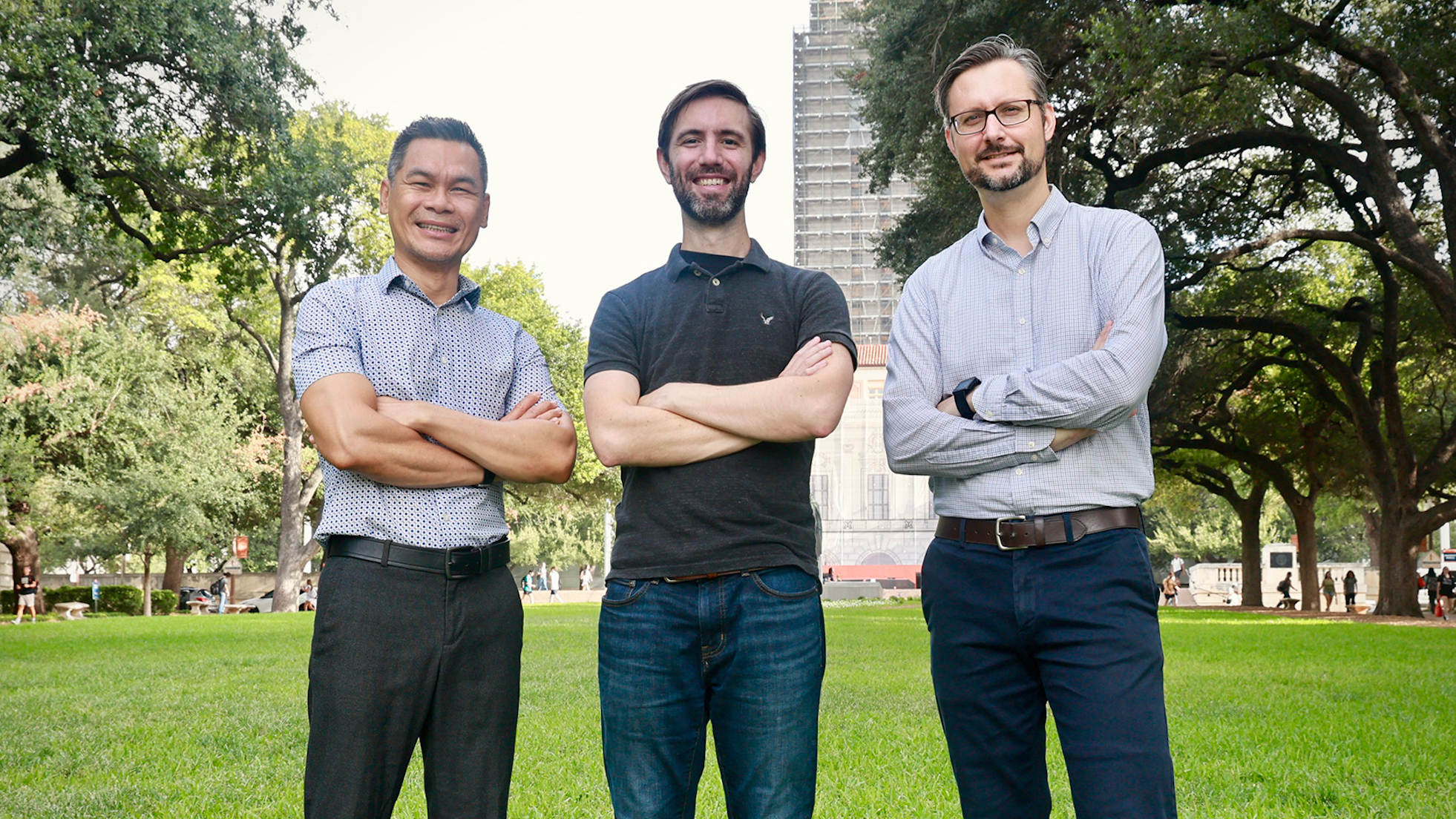
Junyeong Ahn (left) and Joshua Burby (right) have been selected for the DOE Early Career Award.
University of Texas at Austin physicists Junyeong Ahn and Joshua Burby have each won Early Career Research Awards from the U.S. Department of Energy’s Office of Science.
The award is designed to support early-career scientists pursuing rigorous, mission-driven research critical for establishing the nation as a scientific and technological leader, focusing on pivotal, early stage innovative research.
Junyeong Ahn
Ahn’s research looks at chiral superconductors. In a superconductor, electricity moves with zero resistance as electrons pair up and travel collectively, rather than colliding with one another. Chiral superconductors are a special type of material where electron pairs have a preferred direction of rotation. This preference, known as “handedness,” gives rise to unusual quantum properties in the material.
“I’ve been fortunate to work with talented students and postdoctoral researchers whose contributions have been essential,” Ahn said. “This award will allow us to build on that foundation, pursue ambitious long-term research questions and continue attracting and training outstanding young scientists.”
His research proposal involves using circularly polarized light – which is generated by combining light waves at specific angles, and which demonstrates a rotation preference much like the electron pairs in chiral superconductors – to control and manipulate electron movement in chiral superconductors. His research team aims to understand how light can interact with electron pairs and which factors encourage these interactions. Ahn’s research may even help scientists reverse the rotation preference of electron pairs from clockwise to counterclockwise, or vice versa.
“Achieving such control would provide a fundamentally new way to manipulate superconducting quantum states and their properties,” said Ahn, who is part of the University’s Texas Quantum Institute.
Joshua Burby
Burby’s research focuses on the development of fusion energy, which would be cleaner, more sustainable and yield far more energy than burning fossil fuels. His current work focuses on a major challenge hindering fusion energy research: the ability to accurately predict the steady-state conditions in a type of fusion reactor known as a stellarator. In steady-state, all forces acting on a stellarator’s plasma fuel column must balance perfectly. This includes the force produced by turbulent fluctuations of the magnetic field used to contain the plasma. Since most previous reactor designs target low-pressure operations, where the turbulent force is small, scientists have largely ignored magnetic turbulence in their steady-state calculations. But the economics of reactor construction will inevitably push designs to higher pressure, where the turbulent force cannot be overlooked. Modeling the impact of turbulent forces on a stellarator's steady-state equilibrium is an unsolved physics problem.
Burby plans to use the grant to advance an equilibrium model that incorporates the turbulent force for the first time. The project is titled “Sidestepping Grad’s Conjecture,” referring to a 1967 proposal by physicist Harold Grad who stated that fusion reactors require symmetry in how they are built – an idea that severely limits stellarators, which are asymmetrical. A stellarator is like a donut that’s been twisted, it looks different depending on where you’re standing. Burby’s goals include building computer programs based on his new, improved equilibrium model and developing rigorous mathematical proofs that Grad’s conjecture is categorically false for the new model.
“I feel very lucky for the DOE’s support of this research program that touches the foundations of stellarator confinement theory,” Burby said. “I’m going to take my best shot at solving some of the most important riddles in the area.”
A mathematical plasma scientist, Burby is a member of the Institute for Fusion Studies and the Oden Institute for Computational Engineering and Sciences. He also was recently announced as one of the handful of scientists leading a Google.org Impact Challenge.
The Office of Science will grant a total of $96 million to 67 physical science researchers at academic institutions and national labs across the country, all in the early stages of their careers. For Burby, Ahn and other researchers in higher education – spanning 39 universities – each will receive about $875,000 over five years.