Now Fully Online, Simons Observatory Begins Probe of Universe’s Birth
Making the clearest-ever observations of the oldest light could confirm ideas of how the universe came to be.
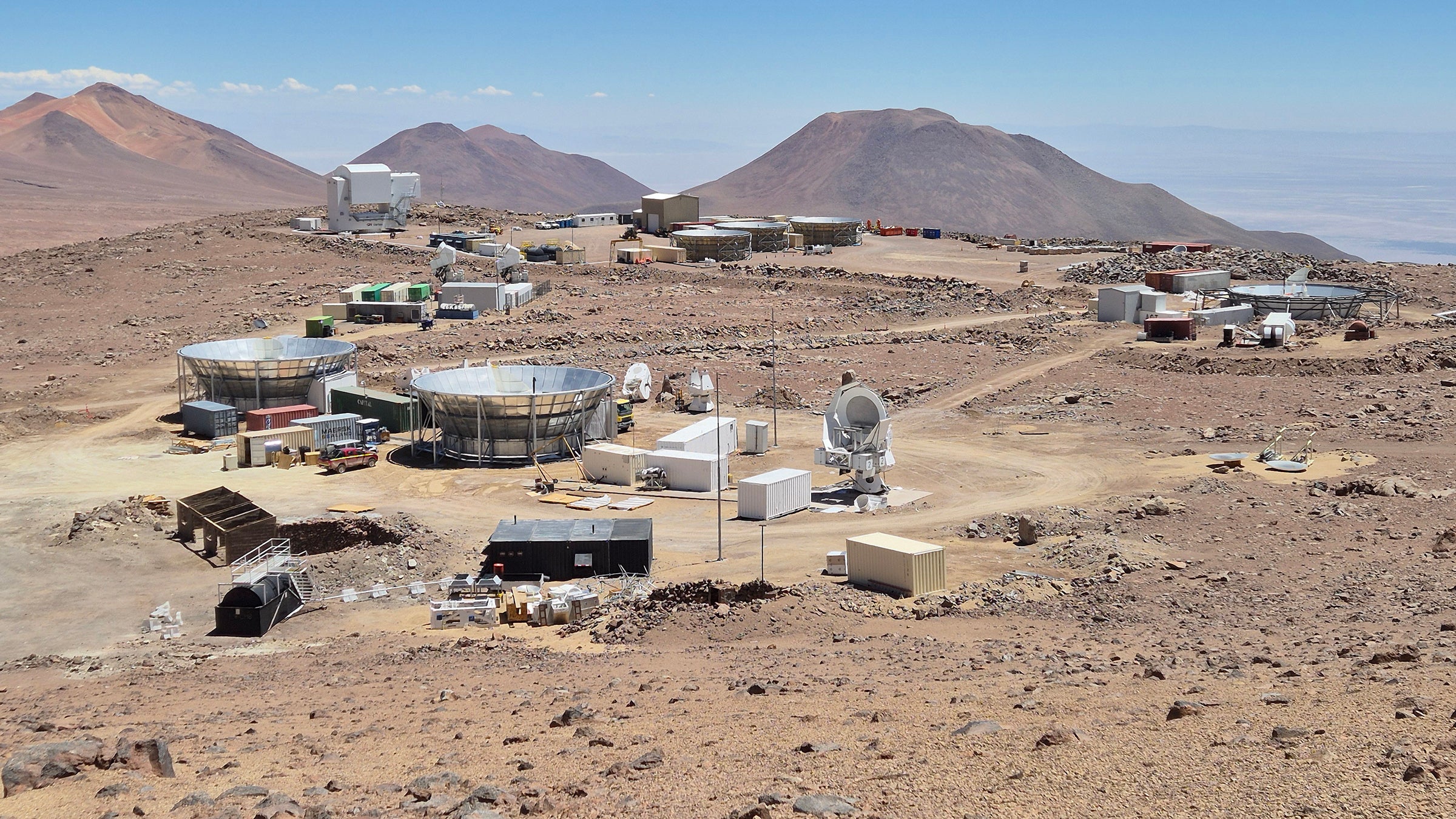
The Simons Observatory site in Chile, showing the Small Aperture Telescopes (SAT) in the foreground inside their ground screens, and the Large Aperture Telescope (LAT) in the background. Credit: Michael Brown for the SO Collaboration. Used under a Creative Commons license (CC BY-SA 4.0).
The search for evidence of what happened during the universe’s first instants—and a long-sought confirmation of the theory of cosmological inflation—is now fully underway.
After two years of carefully calibrating state-of-the-art instruments, ramping up additional telescopes and installing a solar array to help power it all, the Simons Observatory in Chile is completely online and conducting science operations. The University of Texas at Austin is a key member of the consortium building and operating the observatory, with major involvement from physicists Katherine Freese, director of the Weinberg Institute, Kimberly Boddy, director of the Texas Center for Cosmology and Astroparticle Physics, and Nicholas Galitzki, assistant professor of physics.
“To have all the observatory motors humming, gears turning and data flowing makes me joyful, but even more exciting is the prospect of what we could find in its big new deep and detailed maps,” says Simons Observatory Co-Director Suzanne Staggs of Princeton University.
Funded in large part by the Simons Foundation, the observatory houses four telescopes—three Small Aperture Telescopes (SATs) and the Large Aperture Telescope (LAT)—that look out on the cosmos from high in Chile’s Atacama Desert. The observatory’s second phase will add three SATs funded by the United Kingdom and Japan, due to arrive in the coming year.
Read more about working in the high desert of Chile
With tens of thousands of detectors that collect microwave light, the telescopes are primarily searching for delicate signatures in the universe’s oldest light that could help astronomers understand how the cosmos came to be.
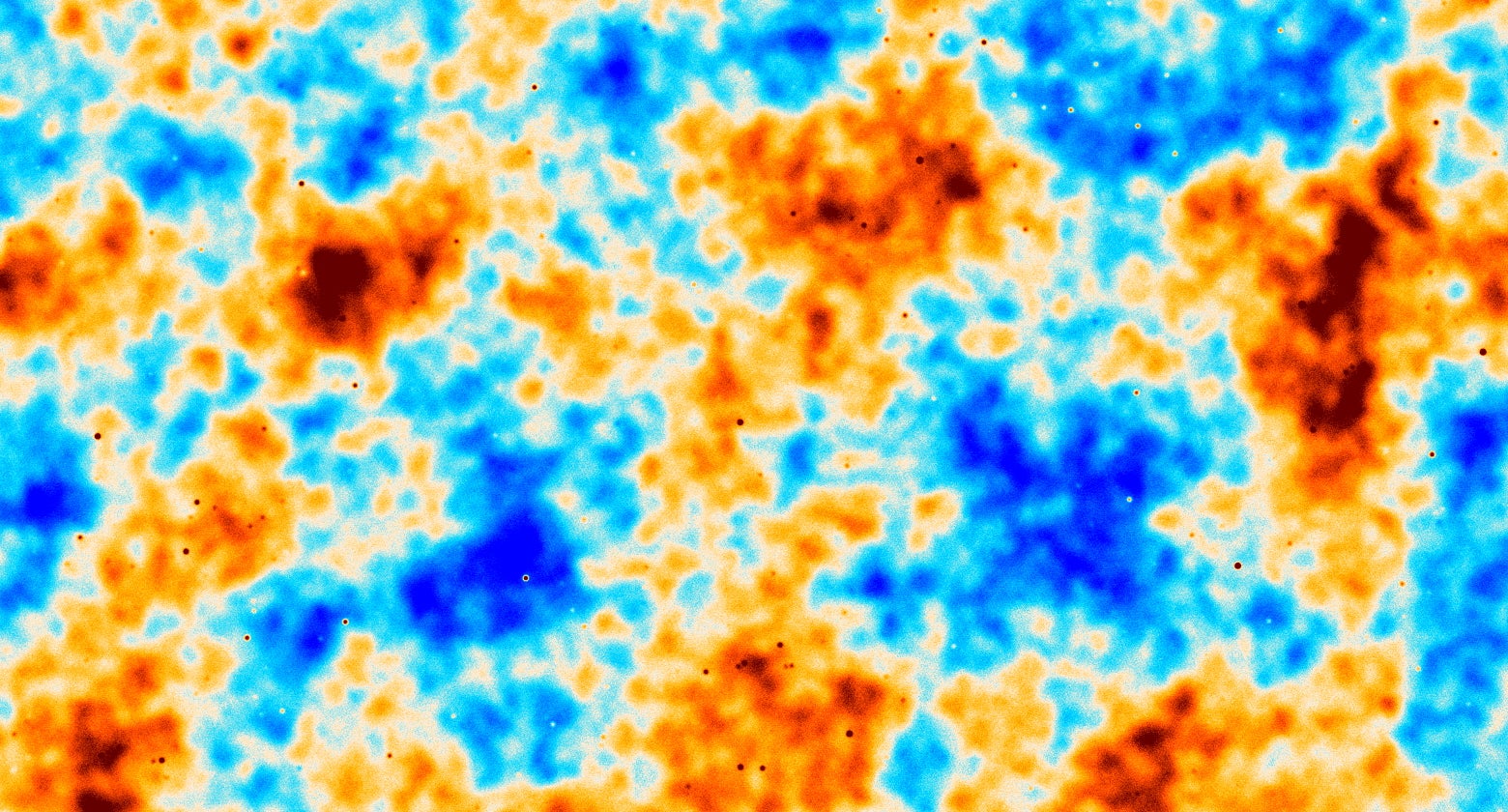
New high-definition image of the cosmic microwave background, which is leftover radiation from the Big Bang, seen with early data from the Simons Observatory. The observatory also captures light from activity around distant supermassive black holes. Credit: Simons Observatory Collaboration. Used under a Creative Commons license (CC BY-SA 4.0).
Seeing the Light
In a tiny fraction of a second after the Big Bang, some 13.8 billion years ago, physicists think the universe rapidly expanded. If true, the slice of the universe we can see today grew from smaller than a subatomic particle to larger than a marble—a massive leap in so short a time. This expansion, called ‘cosmic inflation,’ created ripples in the fabric of space-time, which would eventually have imprinted on the oldest light in the universe we can see. This light, known as the cosmic microwave background (CMB), originated 380,000 years after the Big Bang, when the universe had cooled enough for light to travel billions of light-years without interacting with matter.
Astronomers have been studying the CMB on large scales since the 1980s. CMB observations by different telescopes have led to many pivotal scientific discoveries, including early temperature fluctuations that revealed the seeds for galaxies and the universe’s basic composition, age and rate of expansion. The significance of the discoveries has been recognized by prestigious awards, including the Nobel Prize and the Breakthrough Prize in Fundamental Physics.
Yet despite decades of searching, the cosmic inflation signal in the CMB—which would appear as faint swirling patterns in its polarization—has remained elusive. But with greater sensitivity than ever before, the Simons Observatory hopes to see those swirls, known as ‘B-modes.’ Observations of B-modes, or lack thereof, will help sculpt scientists’ theories and understanding of the very early universe.
While it will be a few years before enough data are collected to reach the sensitivity to possibly detect B-modes, the first observations made by the Simons Observatory are demonstrating its potential. For example, the data collected are already competitive with the best CMB maps, including ones from the European Space Agency’s Planck satellite, which are considered the gold standard.
“After 10 years of working on this experiment, it is incredibly rewarding to see the full capabilities of the Simons Observatory realized,” Galitzki said. “I anticipate producing and publishing our initial science results over the next few years will be a joyful blur.”
The observatory also aims to use its advanced imaging capabilities to study the evolution of galaxies on large scales, transient objects in the Milky Way and beyond, and elementary particles known as neutrinos. By taking a wide-field view of the universe, the Simons Observatory will increase the cadence at which rare cosmic phenomena are captured.
Even in the early stages of science operations, these rare events are showing up. Observations have caught activity around a supermassive black hole, giant flares from a star in the Milky Way and asteroids zipping across the solar system.
The LAT already has produced the most comprehensive images of the Milky Way in polarized microwave light. These types of images give scientists new information about magnetic fields in our galaxy, which is important for understanding star formation and galactic evolution.
“Essentially, right out of the box, just turning on the instrument, we’re making beautiful crisp images of the Milky Way,” Staggs says.
Adapted from a press release by the Simons Foundation.