Allan MacDonald Wins Frontiers of Knowledge Award
The UT Austin physicist was one of two scientists to win the international prize in the category of basic sciences.
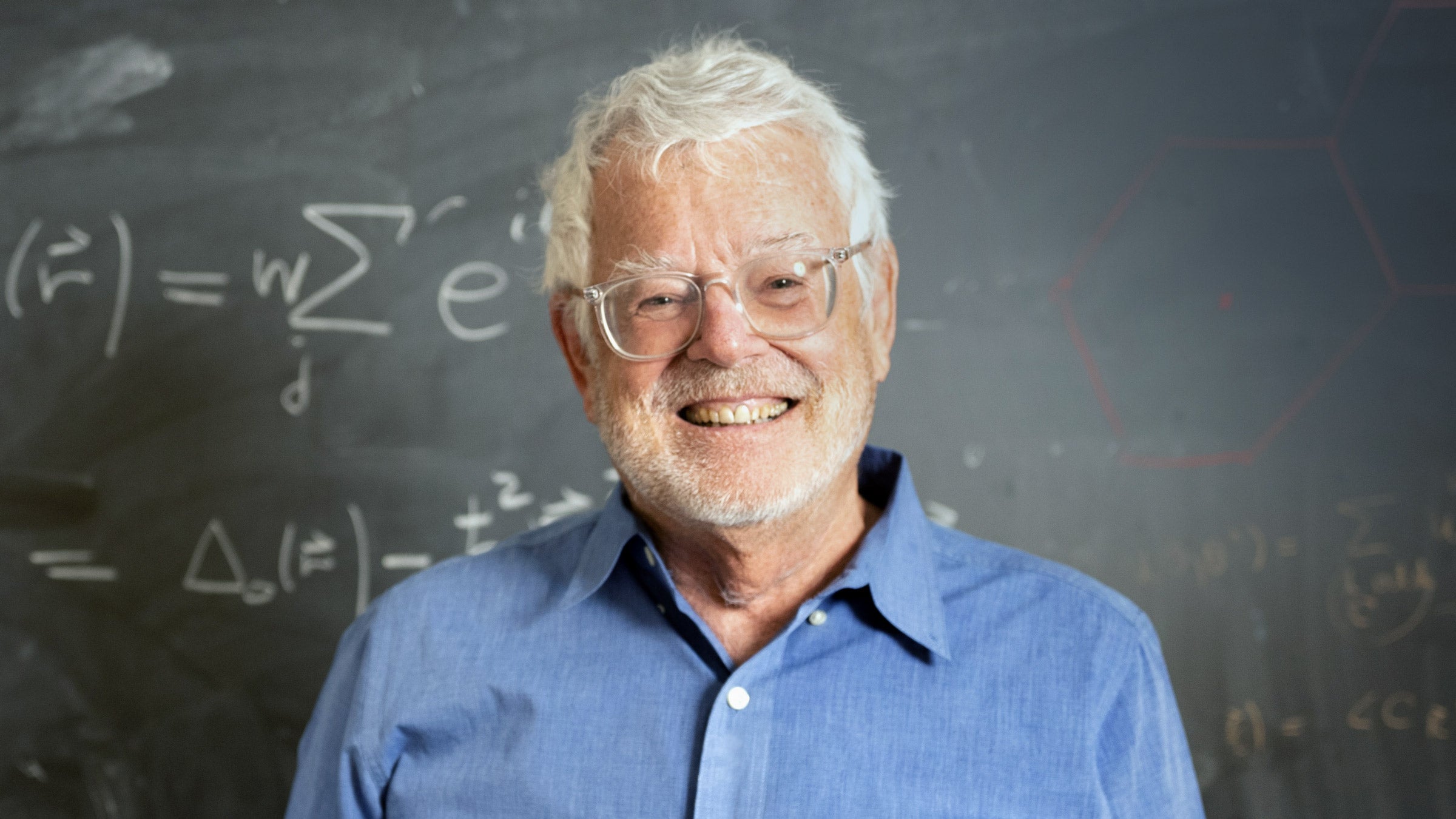
Allan MacDonald, Sid Richardson Chair in Physics at The University of Texas at Austin. Credit: BBVA Foundation
Allan H. MacDonald, a University of Texas at Austin physicist, has won the BBVA Foundation Frontiers of Knowledge Award in basic sciences for his work that has enabled scientists to transform and control extraordinary phenomena linked to new materials.
The award, which is organized in partnership with Spain’s leading public research organization, recognizes contributions of singular impact across various fields, promoting the value of knowledge as a global public good, the best tool at our command to confront the defining challenges of our time and expand individual worldviews.
MacDonald’s prediction from 2011 was validated in 2018 by experimental scientist Pablo Jarillo-Herrero at the Massachusetts Institute of Technology, who shares this year’s award. The BBVA Foundation press announcement credits the pair with driving a whole new field, known as twistronics, where superconductivity, magnetism and other target properties result from rotating ultrathin layers of new materials such as graphene.
In 2011, MacDonald and his team predicted that emerging properties would result from rotating two-dimensional graphene at a specific angle of 1.1 degrees, later termed the “magic angle.” The researchers explained then that electrons would interact differently under those conditions, and Jarillo-Herrero later confirmed that the magic angle unlocked superconductivity. The finding has inspired scientists to leverage the discovery for a wide range of transformative applications — from much more sustainable and efficient electricity transmission to new electronic devices to quantum computing technologies.
Luis Viña, professor of condensed matter physics at the Universidad Autónoma de Madrid and president of the Spanish Royal Physics Society, said MacDonald is defining “a vast new field for developing materials with highly sought-after, emerging properties” and that this has “set the agenda for research groups across the world.”
MacDonald developed an interest in two-dimensional materials and their extraordinary physical properties back in 1988, while at the Max Planck Institute for Solid State Research, working with Nobel laureate Klaus von Klitzing. At UT since 2000, MacDonald has continued researching over decades the physics of two-dimensional materials such as graphene, which is composed of just a single layer of carbon atoms.
In the years since the experimental confirmation of MacDonald’s prediction, scientists around the globe have built on what he set in motion, manipulating new materials to control the behavior of electrons while pursuing applications that could lead to advances like transmitting electricity with almost no energy loss.
“Among the likelier applications are new types of devices to convert information between computers and fiber-optic cables,” MacDonald said. “The technology is promising, and these materials are the best candidates for controlling optical properties electrically.”
The BBVA Foundation has worked with the Spanish National Research Council to give awards each year since 2008 across eight categories that the organizers say define knowledge in the 21st century. Each award comes with 400,000 euros in recognition of its talented recipients, among them world-class scientific researchers.
MacDonald is the first University of Texas at Austin faculty member to win a Frontiers of Knowledge Award in the basic sciences category, but last year, UT College of Natural Sciences alum and ecologist Camille Parmesan won a Frontiers of Knowledge Award in the category for climate change and environmental sciences. In 2018, another alum, immunologist James Allison of the University of Texas MD Anderson Cancer Center took the prize in the biomedicine category.
A native of Nova Scotia, Canada, and a member of the National Academy of Sciences, MacDonald previously won the Wolf Prize in physics. His 1,000 physics publications have more than 110,000 citations, and he has been granted three patents. MacDonald holds UT’s Sid W. Richardson Chair in Physics.