Meet Iris Schmeder, Undergraduate Frog Researcher
A chance encounter in a hallway and hands-on learning opportunities sparked her passion for research.
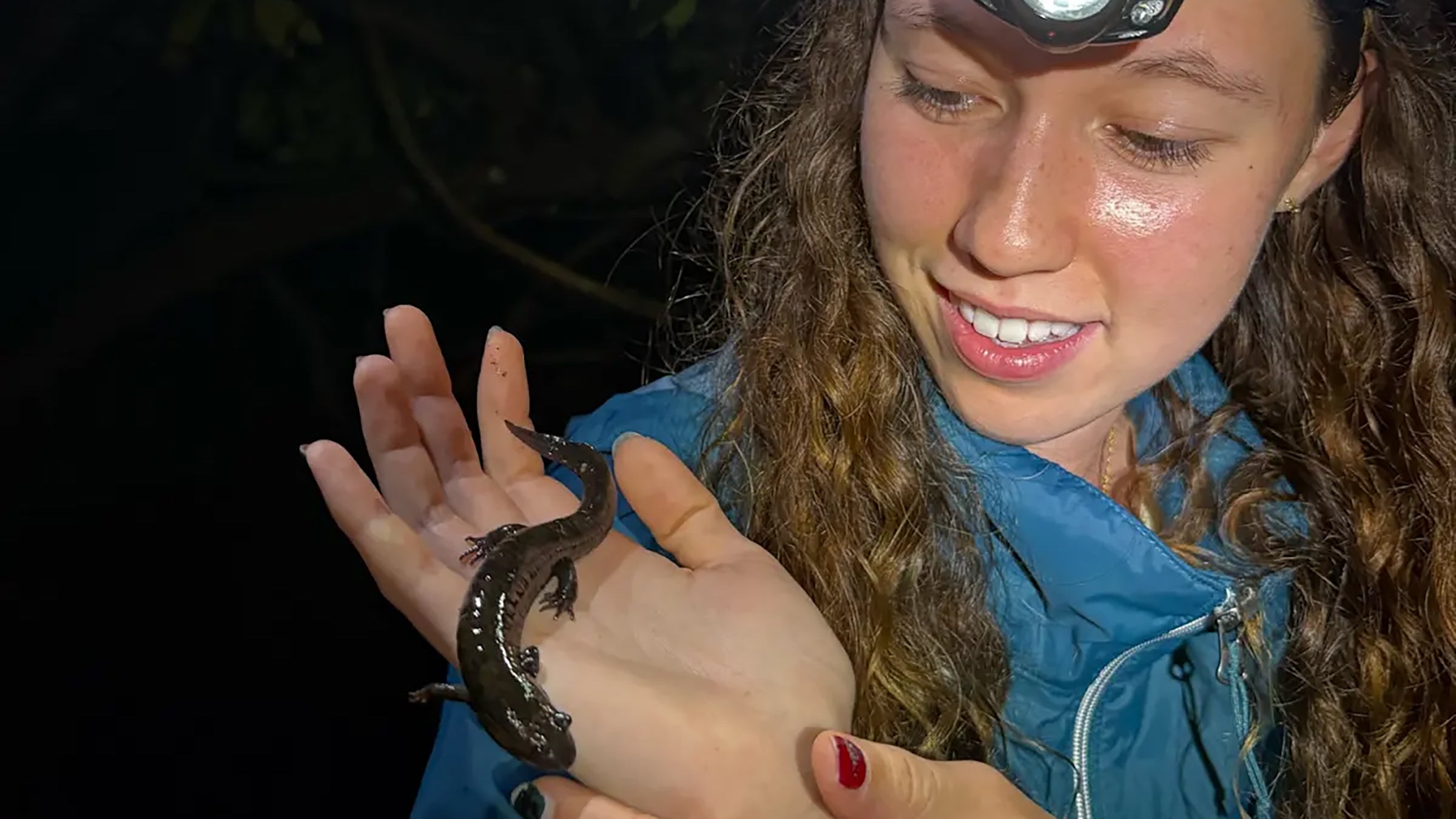
Iris Schmeder holding a dusky salamander (genus Desmognathus) during a rainy night “herp walk.”
Iris Schmeder is a senior biology major who researches the biodiversity and ecology of frogs in the lab of professor Kelly Zamudio at The University of Texas at Austin. She’s also a Dean’s Scholar and a former Stengl-Wyer Biodiversity Scholar who participated in the Freshman Research Initiative.
We caught up with her recently to find out about her time at UT and her plans for the future. This conversation was edited for length and clarity.
Why did you choose UT and how did you end up researching frogs?
One of the main reasons I chose UT was because of the Dean’s Scholars Honors Program and the community and the culture that they had built. It just sounded amazing. I was really interested in research, but I didn’t really know how to do it, and so that’s what really drew me to UT.
During my first week of school, I went to this grad student seminar and I ran into a professor in the hallway and he asked me what I was interested in. And I said, “Well, I just got here, and I like biology, but I don’t really know what I want to do within that. I think animals are cool.” He said, “Well would you ever work with frogs?” And I said, “Yes, frogs are so cool.” And he said, “You should talk to my wife.”
I ended up joining his wife, Kelly Zamudio’s lab and I’m still in it.
What kind of research have you done with frogs?
In the summer of 2025, I did my first frog field work with one of Kelly’s grad students, a different principal investigator, and my best friend, who was an undergrad in Kelly’s lab at the time. The four of us went to Hawaii for a couple weeks to catch coqui frogs, and that was so much fun.
We were studying the invasive coqui frogs and how they have adapted to inhabit a large elevational gradient on the island. To find the frogs, we would go out to the forest at sunset when they became active, split up to cover more ground, and follow a call and scan the trees, ground, branches, leaves and sticks with headlamps until we found the one that was calling. Then we just grabbed it quickly and put it into a plastic bag until we all met up back at the car, transferred them to containers, and then processed them at the end of the night back at the Airbnb. We usually hit 3 field sites a night, driving to different elevations and areas of the island. Some sites were more difficult than others. There was one site that was so dense that Madeline (the other undergrad) and I had to army crawl on the ground and spiderman crawl up trees to maneuver through the forest and track down the frogs. It also rained almost every night, if not every night.
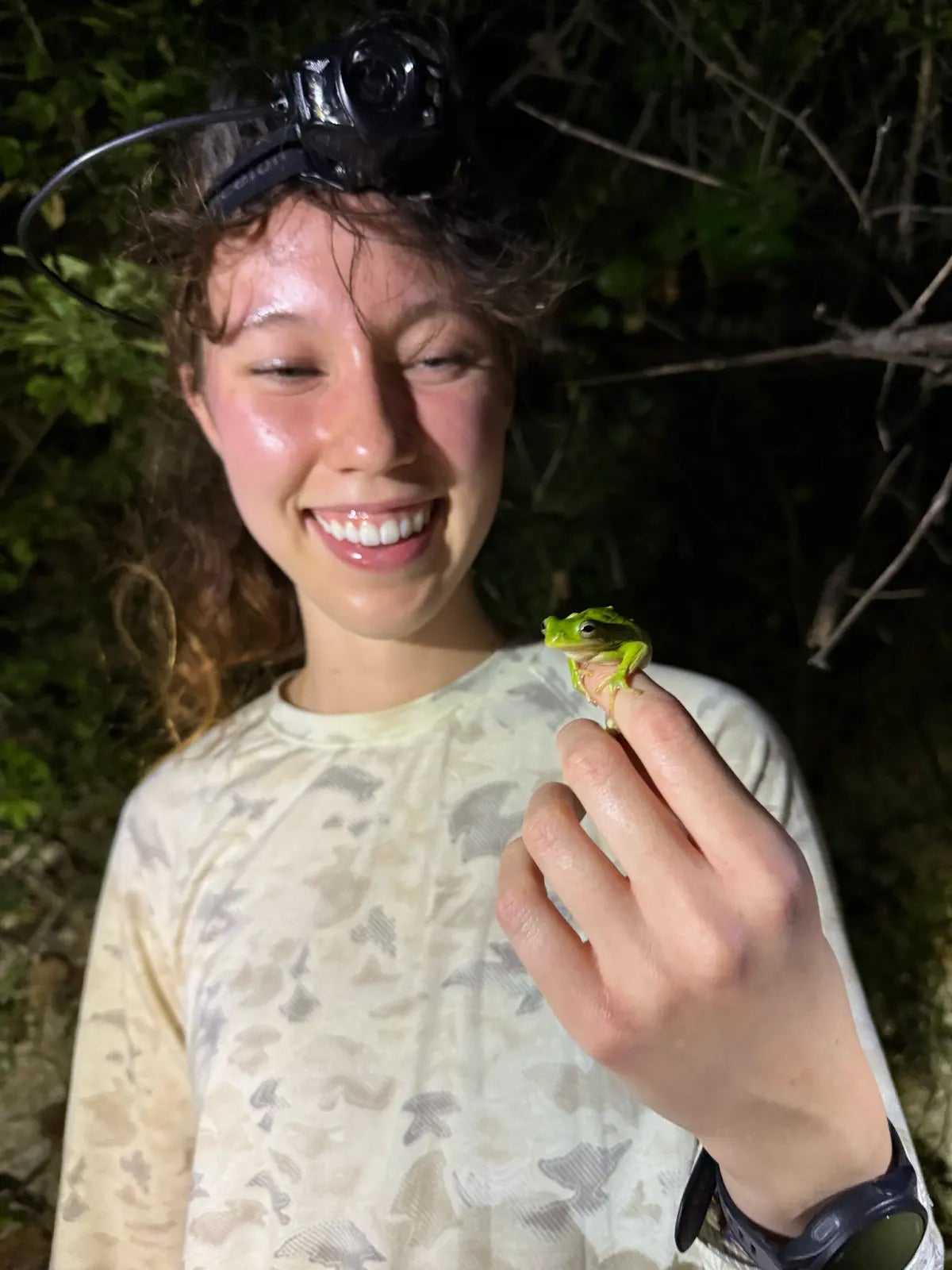
Iris Schmeder holding a green tree frog (Hyla cinerea) that she found during a Herpetology class field trip at McKinney Falls State Park in Austin, Texas.
You were in the Freshman Research Initiative, in the Biodiversity Discovery research stream. What was that like?
One of the best parts is the people that you meet through it. I met two of my best friends, one of them that I went to Hawaii with, and my boyfriend in FRI. And it was like wow, we’re all just such like-minded people. Also FRI really pushes you to think independently and pursue research that is driven by your own questions. So that really inspired me to ask how do I become a research scientist and how do I come up with my own research questions and make them feasible and see it all the way through?
You also interned for the PBS science show ‘Be Smart’ with UT alum Joe Hanson. What was that like?
That was a really cool experience. We worked side by side. I would go into the studio and he would show me around. My project was setting up the workflow and organizing all of the shows. It showed me how much time and thought goes into even a 30-second video. He also taught me how to talk to people and talk to the camera.
A lot of scientists forget that your research is only heard by so many people unless you’re really mindful about science communication and incorporating the general public into it, because that’s where you can really have the biggest impact. That’s where I got really interested in science communication. I’ve tried to carry that experience into my own life by writing little blogs or posting on Instagram, and sharing science with that side of the world. I think it’s important for scientists to try to incorporate that into their daily practices.
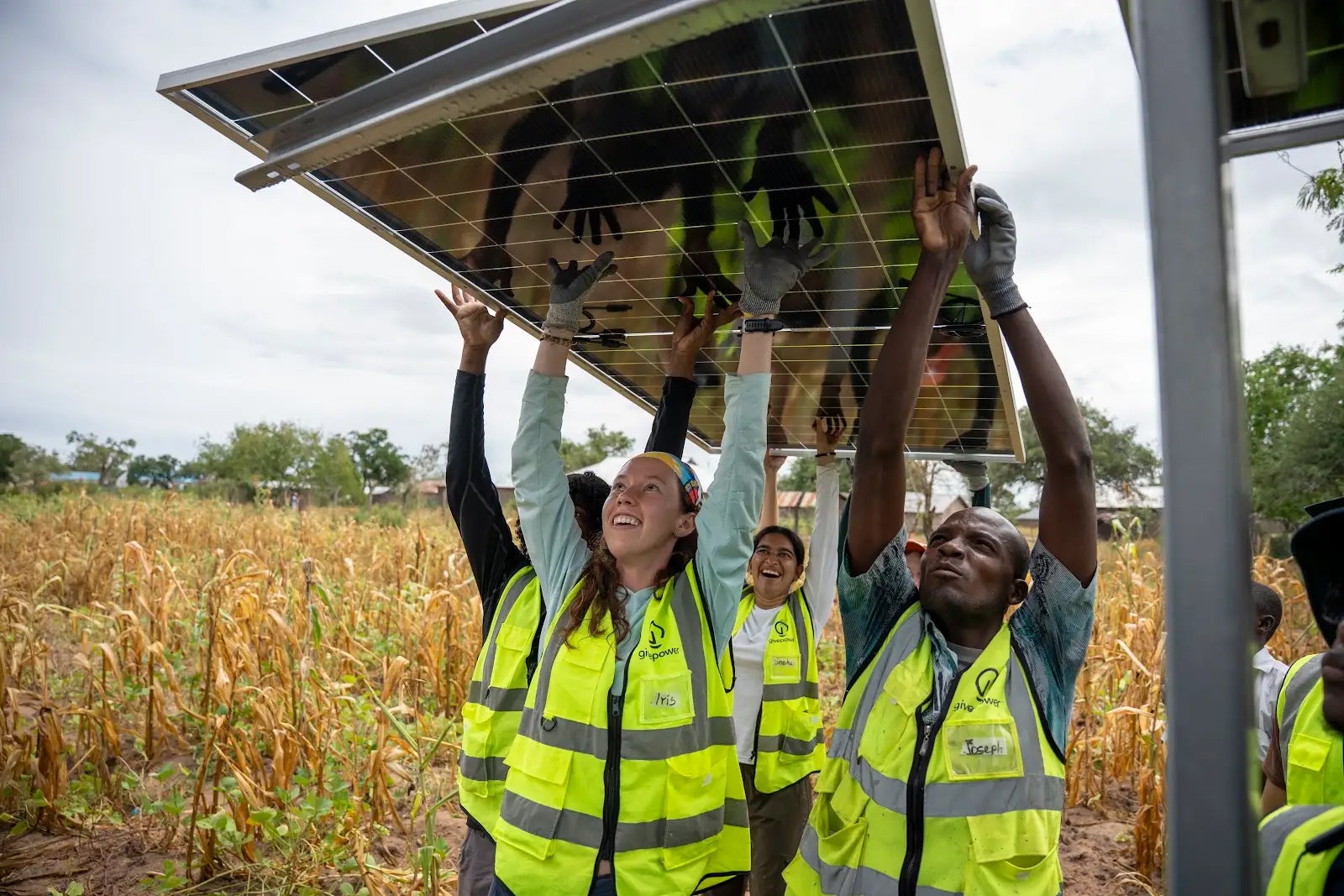
The GivePower team and UT President’s Award for Global Learning students (including Iris Schmeder) installing the last pane of the solar panel grid they built for the medical dispensary in Muryachakwe, Kenya.
What did you do this past summer?
In May, I went to Tanzania and Kenya with the President’s Award for Global Learning program for a project developing an affordable and sustainable water treatment system for homes. We used a co-design system that incorporates local materials, manufacturers, students, designers and engineers.
Before our trip, we tested how well the system removed viruses from water. I also helped make and deliver the educational interventions that we presented at UT Girl Day, at a workshop at the University of Dodoma in Tanzania, and twice at Red Cross Kenya. In the field, I also helped conduct field surveys to determine where communities get their water from and what challenges they face with finding safe and clean drinking water. This semester, I will primarily be working on data analysis and writing for my team’s project.
That was a life-changing experience. It was really impactful to see how a group of UT professors, grad students and undergrads could come together and work in separate teams towards their own research project, but then also collaborate together and travel together, and see our work make a difference.
After that, I also went to India and Austria through the NSF’s International Research Experience for Students program to do more frog research.
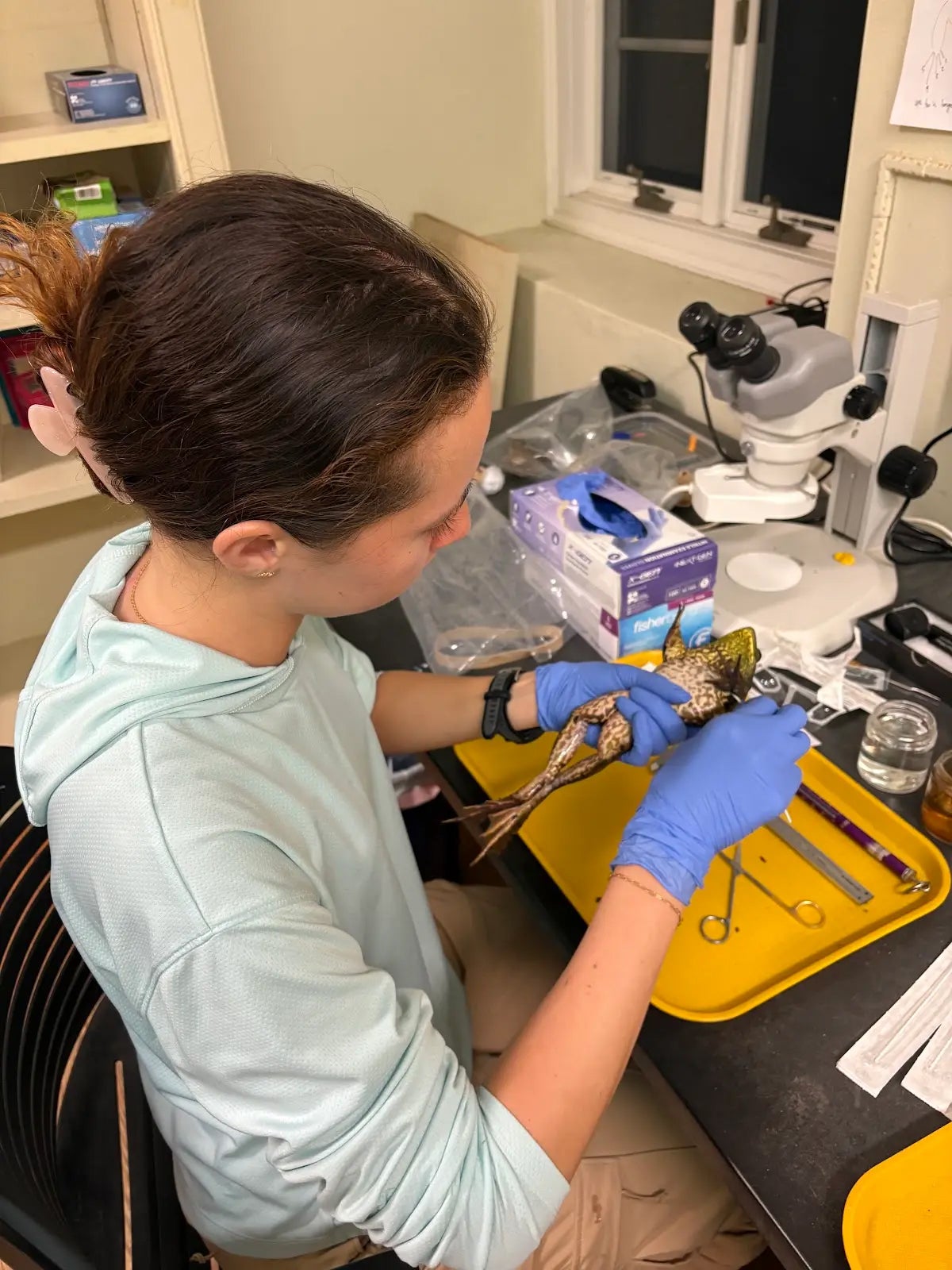
Iris Schmeder swabbing an American bullfrog (Rana catesbeiana) to test for chytrid fungus.
What are you looking forward to in your senior year?
I’m excited for my honors thesis where I’m combining museum records with community science data to evaluate long-term species responses to urbanization across Texas. I’ve been working on it for the past few years and it feels like it’s finally coming together, so it’ll be nice to finally show what I’ve been working so hard on to everyone.
I’m also excited for Vertebrate Natural History, which is a field course taught by an amazing professor, Travis LaDuc. There’s so few courses like that at any university, and I think it really makes UT stand out that there are so many opportunities to get outside and learn in the field.
What are your plans after UT and how have your experiences here helped prepare you?
I’m applying for PhD programs to start next fall. I hope to continue frog research and field work and international traveling for research, for kind of forever.
I think everything’s really built up together and given me a clear image of what I want to do and showed me that it’s possible for me to do it. Especially having Kelly Zamudio as a mentor has been really impactful. She’s very supportive and uplifting and it’s incredible to see someone who’s similar to me in a position that I hope to be in in the future.
I think one of the biggest things that UT has given me, aside from a love for frogs and the knowledge that this field and this pathway is possible, is the idea that people really make the experience, too, and there’s so much that you can learn from everyone, everywhere you go. I have so many incredible memories and incredible friends from UT.
Thinking back to when you were fresh out of high school, what would you tell your younger self or what advice would you give to any incoming freshman?
Talk to everyone. Everyone has their own story, and they have such a unique take on the world and there’s so much that you can learn from even just one conversation. And you never know who people know and what opportunities will open up if you just have a conversation with them. If I didn’t talk to Kelly Zamudio’s husband, professor Harry Greene, during my first week of school outside that grad student talk, who knows where I would be or where I would’ve ended up. That conversation totally changed the trajectory of my life.
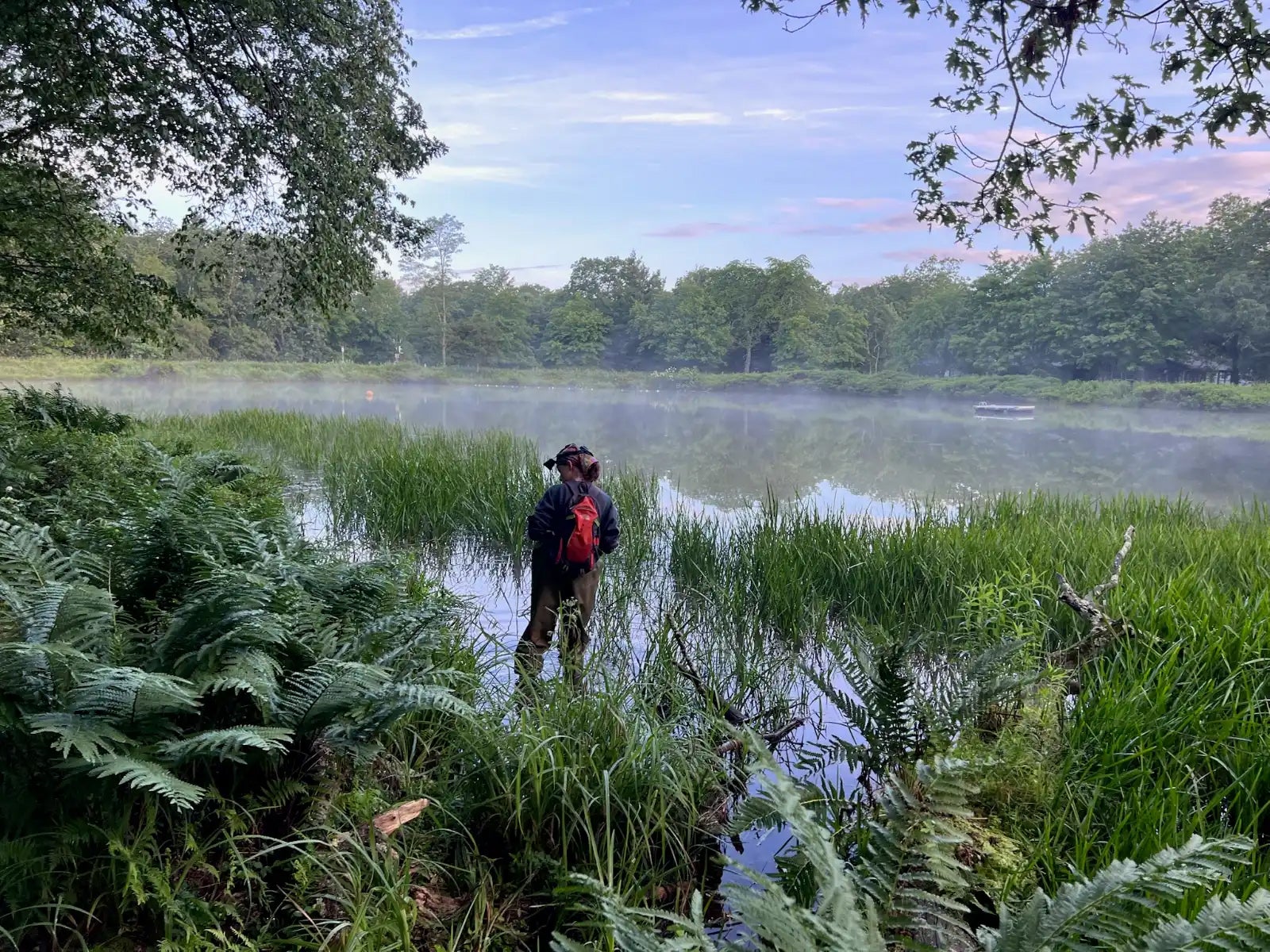
Iris Schmeder searching for pond frogs at dawn for her research project evaluating the prevalence of different pathogens in frog communities at a field station and the potential for mosquitoes to act as vectors of those pathogens.