Jia Leo Li Selected as a 2026 Moore Foundation Experimental Physics Investigator
Selected among only 21 scientists nationwide, Li will be exploring quantum phenomena in atomically thin materials.
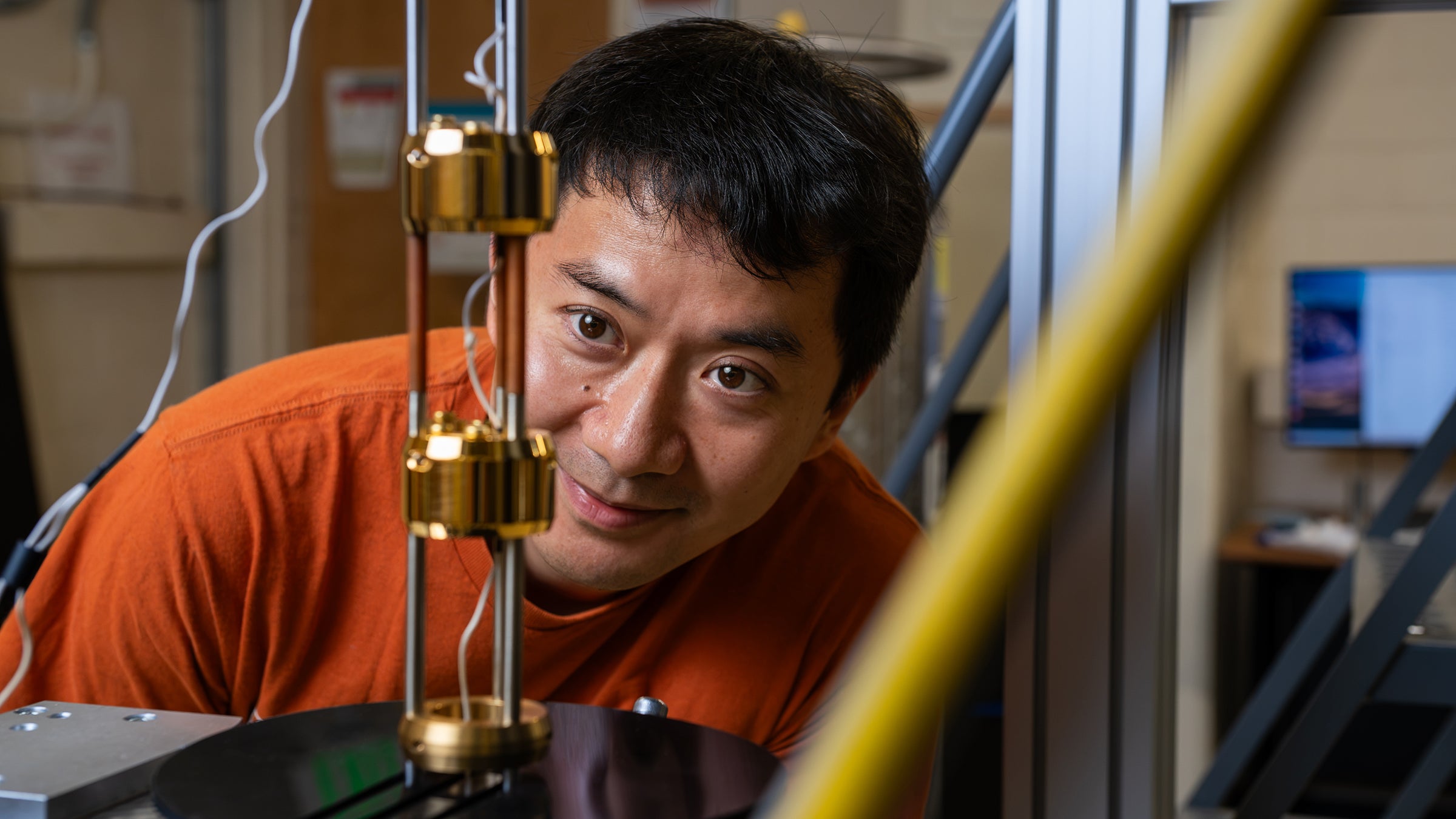
Jia Leo Li. Photo credit: Eileen Chong
Jia Leo Li, an associate professor of physics at The University of Texas at Austin, has been selected by the Gordon and Betty Moore Foundation as a 2026 Experimental Physics Investigator, an award given annually to some of the most exciting experimental physicists conducting research today. Li focuses on quantum phenomena that emerge from electronic systems that include atomically thin, or 2D, materials. His work has the potential to pave the way for engineering materials with far fewer defects than current quantum materials, leading to more efficient electronics and energy technologies.
With this award, Li plans to build a platform that combines two very different systems—free electrons above helium and atomically thin layered materials below—and explore the resulting potential in materials development. The project could also lead to a new type of qubit, the basic building block of quantum computers, needed to make quantum computing practical.
“Many of the technologies we depend on every day, including the chips in our phones, solar panels and rechargeable batteries, will depend on quantum materials for their next leap forward,” Li said. “A key focus of my research is to improve our ability to precisely control the behavior of electrons inside a material.”
Before joining UT Austin, Li was an associate professor of physics at Brown University. His work previously has been recognized with a Sloan Research Fellowship and a National Science Foundation CAREER Award. Li received his Ph.D. from Northwestern University and conducted postdoctoral research at Columbia University.
The Experimental Physics Investigators Initiative provides around 21 investigators annually each with $1.35 million over five years, giving selected scientists the flexibility to accelerate breakthroughs. Li is the second UT physicist studying quantum phenomena to receive the award since 2023, when his Department of Physics colleague Keji Lai was selected.
The 2026 cohort of Experimental Physics Investigators is a distinguished group of mid-career researchers pushing the boundaries of experimental physics.
Support extends beyond the research grants. To help investigators learn from one another, the Initiative brings cohorts together each year in an informal setting built around trading ideas and imagining new experiments, rather than the usual conference format. The initiative also asks investigators to lead well-mentored, high-performing research groups that develop the next generation of scientific talent and supports professional development for investigators toward that goal.
Adapted from a press release by the Gordon and Betty Moore Foundation.