UT Scientists Help Measure Universe’s Expansion with Gravitational Waves
An era of precision gravitational astronomy has arrived, and UT physicists are helping lead the way.
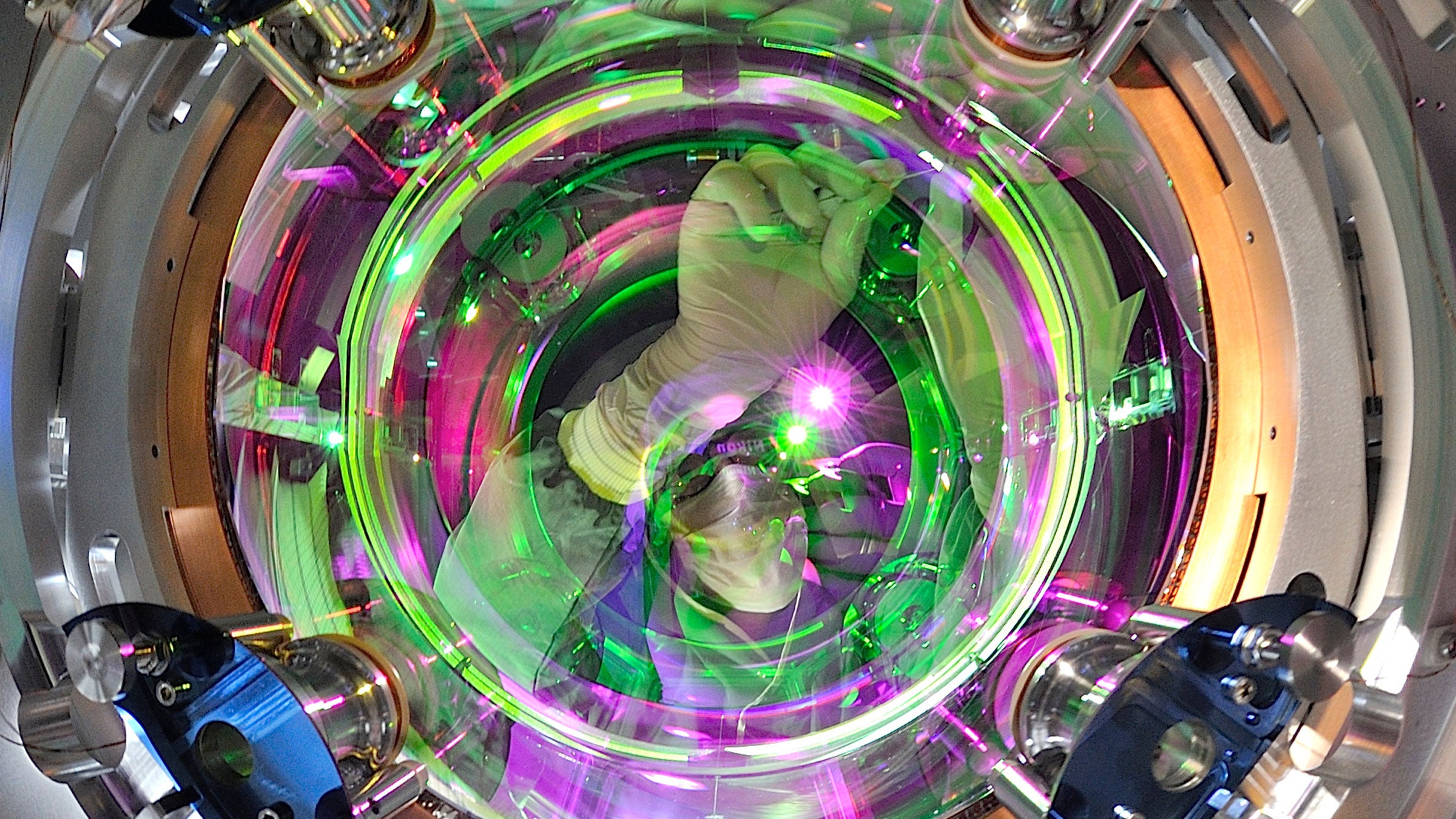
Researcher working on one of the mirrors of the Virgo gravitational wave detector. Photo credit: EGO/Virgo/Maurizio Perciballi
LIGO–Virgo–KAGRA, an international scientific collaboration, has announced a near doubling of the detected ripples in spacetime known as gravitational waves, a set of occurrences that are often brought about by the collision of black holes in the distant cosmos. Among the most exciting discoveries touted today is new work led by a University of Texas at Austin physicist who is working to measure the expansion of the universe.
Hsin-Yu Chen, a UT assistant professor of physics, led a flagship study using the newest catalog of gravitational-wave observations to produce a refined measurement of the Hubble constant, which describes how fast the Universe is expanding. The work is part of the latest results from an international collaboration of scientists, whose new discoveries have been submitted to leading astrophysical journals.
“The Hubble constant tells us how fast the universe is expanding and how old it is. However, different methods of measuring it continue to give conflicting answers, creating the long-standing ‘Hubble tension, in cosmology. If this discrepancy persists, it could mean that our current understanding of the universe is incomplete,” Chen said. “Using a new set of gravitational-wave sources, we obtain an independent measurement of the Hubble constant with about 25% improved precision over previous results. This significant advance highlights the growing power of gravitational-wave astronomy and brings us closer to resolving one of the biggest puzzles in modern cosmology.”
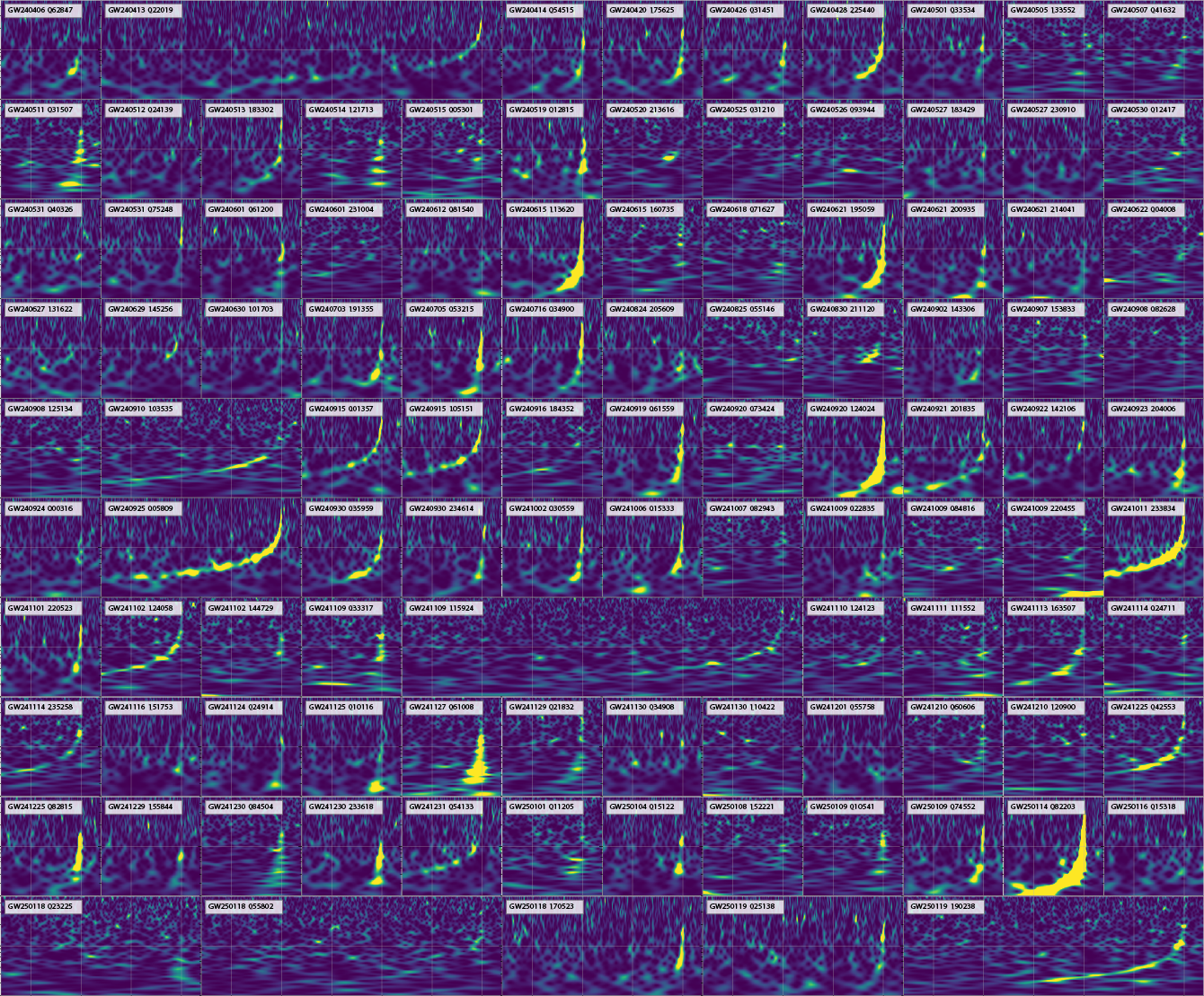
The LIGO–Virgo–KAGRA Collaboration detected these 161 gravitational wave events between April 2024 and the end of January 2025. Each yellow curve represents the rapid shift in frequency of vibrations that zip through the fabric of space when extremely massive objects, often black holes, collide. Credits: Derek Davis / University of Rhode Island / LIGO - Virgo - KAGRA
New discoveries from the international network of scientists were enabled by four gravitational wave detectors – the twin detectors of the U.S. National Science Foundation Laser Interferometer Gravitational-wave Observatory (LIGO), one called Virgo supported by the European Gravitational Observatory and one called KAGRA in Japan’s Institute for Cosmic Ray Research. Since the previous data release from LIGO-Virgo-Kagra (LVK), detector upgrades have allowed for increasing sensitivity and led to extraordinary growth in the number of gravitational waves being found. Scientists had never detected the long-predicted ripples in spacetime a dozen years ago, but now members of the collaboration can find multiple gravitational waves in a given week. The latest observing run found a total of 161 gravitational waves, detected between April 2024 and the end of January 2025, bringing the total number of gravitational wave signals detected since the first discovery in 2015 to 390.
“The extraordinary sensitivity of our detectors now allows us to capture three or four gravitational wave signals every week,” said Ed Porter, researcher at the Laboratoire Astroparticule et Cosmologie of France’s National Centre for Scientific Research. “This ever-growing wealth of data, which an entire community of scientists and astronomers is working to analyze and study, has taken us from the era of initial discoveries into that of precision gravitational astronomy. Today, gravitational wave studies make possible analyses that were previously unimaginable: investigations into black hole populations, increasingly precise tests of general relativity under the extreme physical conditions of the phenomena we observe and the development of new methods to obtain ever more accurate estimates of the Hubble constant. It is a scenario that not many people would have bet on just 10 years ago.”
Improvements in the LKV’s ability to localize events, along with the increase in the size of the dataset, were key for the better estimate of the Hubble constant. Using the new dataset, the LVK collaboration obtained a new, independent measurement of the Hubble constant, which is just over 25% more precise than the estimate coming from the previous catalog release. This value is consistent with long-established measurements from both our cosmic neighborhood and the early universe but is not yet precise enough to resolve the tension between those measurements.
Several members of UT’s Center for Gravitational Physics participated in the collaboration’s latest observing run. Another UT physicist, Aaron Zimmerman, chaired the editorial board for the various papers submitted by the collaboration to Astrophysical Journal and Astrophysical Journal Letters.
The new catalog includes several detections that are themselves exceptional and sets new records in gravitational-wave astronomy observations: the best sky localization ever achieved for a gravitational wave source, the clearest gravitational wave signal ever recorded and evidence for the existence of second-generation black holes.
Adapted from a release by the European Gravitational Observatory.