Biochemistry Major Tu-Quyen Dao is Integrating AI Into Healthcare
Tu-Quyen Dao, a senior biochemistry student, is studying how AI can be applied to improve healthcare.
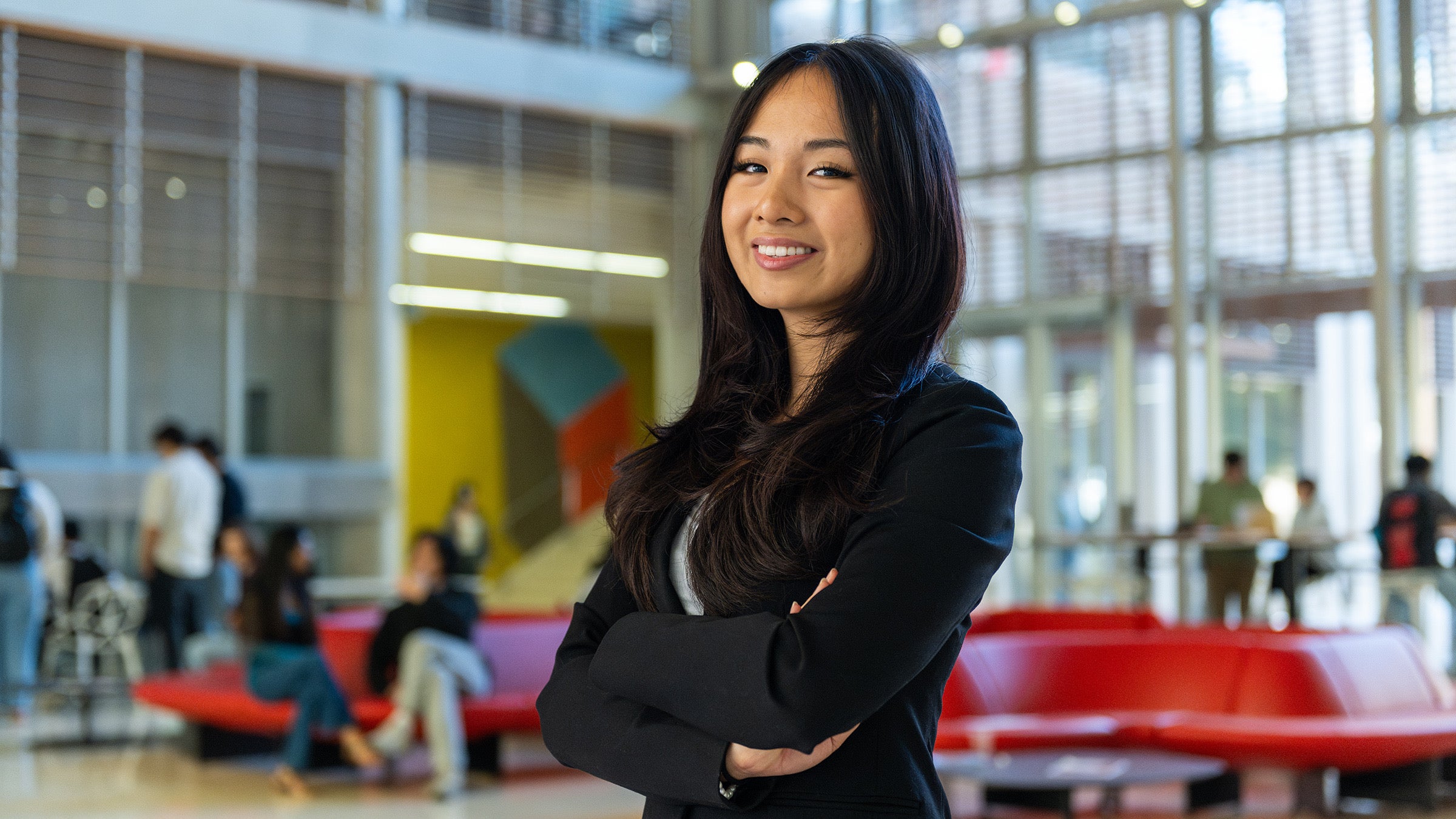
Tu-Quyen Dao. Photo credit: Eileen Chong.
I understand that you were involved in a research project with assistant professor Arya Farahi studying pain and speech. Can you tell me more about that experience?
The project is called TAME Pain, which stands for Trustworthy AssessMEnt of Pain, and I was involved as a research assistant. I remember being really excited, but because this was the first research project I had ever done, I had no idea what to expect. The study was motivated by the fact that pain assessment is important for correct diagnosis and treatment, but it’s currently measured subjectively and is inaccurate a lot of the time. So, the goal of this project was to support the development of AI technologies that can measure pain objectively. We approached this by exploring potential vocal biomarkers for pain, running our own data collection trials with human participants.
What kind of data did you collect?
We collected audio from participants as they read a series of sentences while they were exposed to a pain stimulus (holding an arm in an ice water bath), then a control condition (warm water bath). This was an interesting experience because you couldn’t focus only on the data being collected—you also had to focus on other aspects like ethics, safety, scheduling, coordination and communication when working with human participants. At the end of the data collection process, we ended up with over 7,000 audio files to annotate and analyze. I manually listened to all the audio clips, annotated them and then analyzed the data using RStudio to see if there were any potential signals in the speech data that may indicate the presence of biomarkers for pain. I had only taken one statistics class before, so it was a new experience compared to the classes I'm usually used to, like biology and chemistry.
What did you find?
We represented the data with graphs, comparing different categories of annotations to a baseline graph with all data points. Through this visual analysis, we found that audio files labeled as having an audible breath deviated the most from the baseline and correlated with reports of higher pain levels, which means that this attribute may contribute as a potential biomarker for pain. In the end, we released our entire dataset, annotations and preliminary analysis to the research community. Especially since there are no other public datasets that directly explore the relationship between speech and pain, our dataset can enable other researchers to train and test models to develop objective pain assessment technologies.
How did this project shape your perspective on research?
Before I joined the study, I only wanted to practice medicine and was not really interested in doing research in the future. But I realized that research is more engaging than the standard process we learn about in class, and it actually requires a lot of creativity and collaboration. For TAME Pain, we collaborated with researchers from the UK and our team was made of different disciplines, with experts in medicine, psychology, audiology, AI and computer science. I was constantly learning something new, and I realized how essential a multidisciplinary team is, especially in a project like this one.
How has your attitude towards AI evolved throughout your research journey?
Initially, it was my skepticism that motivated me to join TAME Pain. Trying to detect pain with the sound of your voice was a really unfamiliar concept to me. In my role as a research assistant, Irealized that the process towards AI development is really difficult, requiring high-quality data, manual labor like annotations and training and testing that requires a lot of trial and error. But looking at the bigger picture, I realized that AI can be a powerful tool that draws upon patterns that humans are not capable of recognizing themselves. I know there’s talk about how AI can take over jobs, but I think it can actually augment our work, especially in healthcare. And the integration of AI into healthcare is inevitable, so it’s not a question of “if” but “how.” This realization led me into the research I’m doing now with the University’s IC2 Institute, studying how clinicians use AI in their medical practice and how that use is reshaping and redefining their skills, expertise and role as a clinician. I’m excited about the potential of leveraging AI for betterpatient outcomes.
Tell me about your experiences engaging with the community through the Health Leadership Apprentice Program, Dell Medical School’s undergraduate experiential learning program.
Through volunteering in hospitals, I’ve seen how patient outcomes are heavily influenced by events outside the hospital like social determinants of health or pre-hospital emergency preparedness. Through HLA, I have the opportunity to do more community-based research, with a focus on preventative medicine. Last year in HLA, I worked on a team to identify challenges and opportunities related to social determinants of health among women and girls in the Austin community. This year, I am working on a team to implement first aid training for underserved communities because first-aid response from a bystander can be lifesaving, but many lack the knowledge to make it effective. As a physician in the future, I want to not only help people in the hospital but also try to keep them out of the hospital by advocating for community engagement and preventative medicine.
What are your future career goals?
I want to eventually become a physician and continue to do research. A dream of mine is to help underserved populations by joining Doctors Without Borders. My passion for it started when I took a trip to Vietnam and saw their hospitals and learned about their healthcare system. There, many doctors do not get paid well, especially if they are working for a public hospital, so there'sa shortage of doctors and a lot of corruption which creates huge disparities between patients with different socioeconomic statuses. I'm aware through what I learned in my certificate in Social Inequality, Health, & Policy that many other countries face similar issues, especially in rural areas or when an area has an internal conflict or disease outbreak. I hope I can have an opportunity to work in some of these underserved countries and play a part in making healthcare more equitable.